Showing posts with label library history. Show all posts

Thursday, June 25, 2020

Women designing


Those of us in the library community are generally aware of our premier "designing woman," the so-called "Mother of MARC," Henriette Avram. Avram designed the MAchine Reading Cataloging record in the mid-1960's, a record format that is still being used today. MARC was way ahead of its time using variable length data fields and a unique character set that was sufficient for most European languages, all thanks to Avram's vision and skill. I'd like to introduce you here to some of the designing women of the University of California library automation project, the project that created one of the first online catalogs in the beginning of the 1980's, MELVYL. Briefly, MELVYL was a union catalog that combined data from the libraries of the nine (at that time) University of California campuses. It was first brought up as a test system in 1980 and went "live" to the campuses in 1982.

Work on the catalog began in or around 1980, and various designs were put forward and tested. Key designers were Linda Gallaher-Brown, who had one of the first masters degrees in computer science from UCLA, and Kathy Klemperer, who like many of us was a librarian turned systems designer.

We were struggling with how to create a functional relational database of bibliographic data (as defined by the MARC record) with computing resources that today would seem laughable but were "cutting edge" for that time. I remember Linda remarking that during one of her school terms she returned to her studies to learn that the newer generation of computers would have this thing called an "operating system" and she thought "why would you need one?" By the time of this photo she had come to appreciate what an operating system could do for you. The one we used at the time was IBM's OS 360/370.

Kathy Klemperer was the creator of the database design diagrams that were so distinctive we called them "Klemperer-grams." Here's one from 1985:
MELVYL database design Klemperer-gram, 1985
Drawn and lettered by hand, not only did these describe a workable database design, they were impressively beautiful. Note that this not only predates the proposed 2009 RDA "database scenario" for a relational bibliographic design by 24 years, it provides a more detailed and most likely a more accurate such design.
RDA "Scenario 1" data design, 2009
In the early days of the catalog we had a separate file and interface for the cataloged serials based on a statewide project (including the California State Universities). Although it was possible to catalog serials in the MARC format, the systems that had the detailed information about which issues the libraries held was stored in serials control databases that were separate from the library catalog, and many serials were represented by crusty cards that had been created decades before library automation. The group below developed and managed the CALLS (California Academic Library List of Serials). Four of those pictured were programmers, two were serials data specialists, and four had library degrees. Obviously, these are overlapping sets. The project heads were Barbara Radke (right) and Theresa Montgomery (front, second from right).

At one point while I was still working on the MELVYL project, but probably around the very late 1990's or early 2000's, I gathered up some organization charts that had been issued over the years and quickly calculated that during its history the project the technical staff that had created this early marvel had varied from 3/4 to 2/3 female. I did some talks at various conferences in which I called MELVYL a system "created by women." At my retirement in 2003 I said the same thing in front of the entire current staff, and it was not well-received by all. In that audience was one well-known member of the profession who later declared that he felt women needed more mentoring in technology because he had always worked primarily with men, even though he had indeed worked in an organization with a predominantly female technical staff, and another colleague who was incredulous when I stated once that women are not a minority, but over 50% of the world's population. He just couldn't believe it.

While outright discrimination and harassment of women are issues that need to be addressed, the invisibility of women in the eyes of their colleagues and institutions is horribly damaging. There are many interesting projects, not the least the Wikipedia Women in Red, that aim to show that there is no lack of accomplished women in the world, it's the acknowledgment of their accomplishments that falls short. In the library profession we have many women whose stories are worth telling. Please, let's make sure that future generations know that they have foremothers to look to for inspiration.

Monday, May 25, 2020

1982

I've been trying to capture what I remember about the early days of library automation. Mostly my memory is about fun discoveries in my particular area (processing MARC records into the online catalog). I did run into an offprint of some articles in ITAL from 1982 (*) which provide very specific information about the technical environment, and I thought some folks might find that interesting. This refers to the University of California MELVYL union catalog, which at the time had about 800,000 records.

Operating system: IBM 360/370
Programming language: PL/I
CPU: 24 megabytes of memory
Storage: 22 disk drives, ~ 10 gigabytes
DBMS: ADABAS

The disk drives were each about the size of an industrial washing machine. In fact, we referred to the room that held them as "the laundromat."

Telecommunications was a big deal because there was no telecommunications network linking the libraries of the University of California. There wasn't even one connecting the campuses at all. The article talks about the various possibilities, from an X.25 network to the new TCP/IP protocol that allows "internetwork communication." The first network was a set of dedicated lines leased from the phone company that could transmit 120 characters per second (character = byte) to about 8 ASCII terminals at each campus over a 9600 baud line. There was a hope to be able to double the number of terminals.

In the speculation about the future, there was doubt that it would be possible to open up the library system to folks outside of the UC campuses, much less internationally. (MELVYL was one of the early libraries to be open access worldwide over the Internet, just a few years later.) It was also thought that libraries would charge other libraries to view their catalogs, kind of like an inter-library loan.

And for anyone who has an interest in Z39.50, one section of the article by David Shaughnessy and Clifford Lynch on telecommunications outlines a need for catalog-to-catalog communication which sounds very much like the first glimmer of that protocol.

-----

(*) Various authors in a special edition: (1982). In-Depth: University of California MELVYL. Information Technology and Libraries, 1(4)

I wish I could give a better citation but my offprint does not have page numbers and I can't find this indexed anywhere. (Cue here the usual irony that libraries are terrible at preserving their own story.)

Tuesday, January 28, 2020

Pamflets

I was always a bit confused about the inclusion of "pamflets" in the subtitle of the Decimal System, such as this title page from the 1922 edition:


Did libraries at the time collect numerous pamphlets? For them to be the second-named type of material after books was especially puzzling.

I may have discovered an answer to my puzzlement, if not THE answer, in Andrea Costadoro's 1856 work:
A "pamphlet" in 1856 was not (necessarily) what I had in mind, which was a flimsy publication of the type given out by businesses, tourist destinations, or public health offices. In the 1800's it appears that a pamphlet was a literary type, not a physical format. Costadoro says:
"It has been a matter of discussion what books should be considered pamphlets and what not. If this appellation is intended merely to refer to the SIZE of the book, the question can be scarecely worth considering ; but if it is meant to refer to the NATURE of a work, it may be considered to be of the same class and to stand in the same connexion with the word Treatise as the words Tract ; Hints ; Remarks ; &c, when these terms are descriptive of the nature of the books to which they are affixed." (p. 42)
To be on the shelves of libraries, and cataloged, it is possible that these pamphlets were indeed bound, perhaps by the library itself. 

The Library of Congress genre list today has a cross-reference from "pamphlet" to "Tract (ephemera)". While Costadoro's definition doesn't give any particular subject content to the type of work, LC's definition says that these are often issued by religious or political groups for proselytizing. So these are pamphlets in the sense of the political pamphlets of our revolutionary war. Today they would be blog posts, or articles in Buzzfeed or Slate or any one of hundreds of online sites that post such content.

Churches I have visited often have short publications available near the entrance, and there is always the Watchtower, distributed by Jehovah's Witnesses at key locations throughout the world, and which is something between a pamphlet (in the modern sense) and a journal issue. These are probably not gathered in most libraries today. In Dewey's time the printing (and collecting by libraries) of sermons was quite common. In a world where many people either were not literate or did not have access to much reading material, the Sunday sermon was a "long form" work, read by a pastor who was probably not as eloquent as the published "stars" of the Sunday gatherings. Some sermons were brought together into collections and published, others were published (and seemingly bound) on their own.  Dewey is often criticized for the bias in his classification, but what you find in the early editions serves as a brief overview of the printed materials that the US (and mostly East Coast) culture of that time valued. 

What now puzzles me is what took the place of these tracts between the time of Dewey and the Web. I can find archives of political and cultural pamphlets in various countries and they all seem to end around the 1920's-30's, although some specific collections, such as the Samizdat publications in the Soviet Union, exist in other time periods.

Of course the other question now is: how many of today's tracts and treatises will survive if they are not published in book form?

Tuesday, August 08, 2017

On reading Library Journal, September, 1877

Of the many advantages to retirement is the particular one of idle time. And I will say that as a librarian one could do no better than to spend some of that time communing with the history of the profession. The difficulty is that it is so rich, so familiar in many ways that it is hard to move through it quickly. Here is just a fraction of the potential value to be found in the September issue of volume two of Library Journal.* Admittedly this is a particularly interesting number because it reports on the second meeting of the American Library Association.

For any student of library history it is especially interesting to encounter certain names as living, working members of the profession.


Other names reflect works that continued on, some until today, such as Poole and Bowker, both names associated with long-running periodical indexes.

What is particularly striking, though, is how many of the topics of today were already being discussed then, although obviously in a different context. The association was formed, at least in part, to help librarianship achieve the status of a profession. Discussed were the educating of the public on the role of libraries and librarians as well as providing education so that there could be a group of professionals to take the jobs that needed that professional knowledge. There was work to be done to convince state legislatures to support state and local libraries.

One of the first acts of the American Library Association when it was founded in 1876 (as reported in the first issue of Library Journal) was to create a Committee on Cooperation. This is the seed for today's cooperative cataloging efforts as well as other forms of sharing among libraries. In 1877, undoubtedly encouraged by the participation of some members of the publishing community in ALA, there was hope that libraries and publishers would work together to create catalog entries for in-print works.
This is one hope of the early participants that we are still working on, especially the desire that such catalog copy would be "uniform." Note that there were also discussions about having librarians contribute to the periodical indexes of R. R. Bowker and Poole, so the cooperation would flow in both directions.

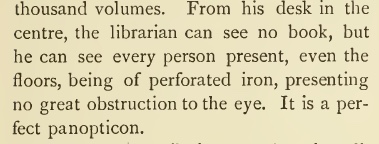
The physical organization of libraries also was of interest, and a detailed plan for a round (actually octagonal) library design was presented:
His conclusion, however, shows a difference in our concepts of user privacy.
Especially interesting to me are the discussions of library technology. I was unaware of some of the emerging technologies for reproduction such as the papyrograph and the electric pen. In 1877, the big question, though, was whether to employ the new (but as yet un-perfected) technology of the typewriter in library practice.

There was some poo-pooing of this new technology, but some members felt it may be reaching a state of usefulness.


"The President" in this case is Justin Winsor, Superintendent of the Boston Library, then president of the American Library Association. Substituting more modern technologies, I suspect we have all taken part in this discussion during our careers.

Reading through the Journal evokes a strong sense of "le plus ça change..." but I admit that I find it all rather reassuring. The historical beginnings give me a sense of why we are who we are today, and what factors are behind some of our embedded thinking on topics.


* Many of the early volumes are available from HathiTrust, if you have access. Although the texts themselves are public domain, these are Google-digitized books and are not available without a login. (Don't get me started!) If you do not have access to those, most of the volumes are available through the Internet Archive. Select "text" and search on "library journal". As someone without HathiTrust institutional access I have found most numbers in the range 1-39, but am missing (hint, hint): 5/1880; 8-9/1887-88; 17/1892; 19/1894; 28-30/1903-1905; 34-37;1909-1912. If I can complete the run I think it would be good to create a compressed archive of the whole and make that available via the Internet Archive to save others the time of acquiring them one at a time. If I can find the remainder that are pre-1923 I will add those in.