Showing posts with label FRBR. Show all posts

Saturday, November 23, 2019

The Work

The word "work" generally means something brought about by human effort, and at times implies that this effort involves some level of creativity. We talk about "works of art" referring to paintings hanging on walls. The "works" of Beethoven are a large number of musical pieces that we may have heard. The "works" of Shakespeare are plays, in printed form but also performed. In these statements the "work" encompasses the whole of the thing referred to, from the intellectual content to the final presentation.

This is not the same use of the term as is found in the Library Reference Model (LRM). If you are unfamiliar with the LRM, it is the successor to FRBR (which I am assuming you have heard of) and it includes the basic concepts of work, expression, manifestation and item that were first introduced in that previous study. "Work," as used in the LRM is a concept designed for use in library cataloging data. It is narrower than the common use of the term illustrated in the previous paragraph and is defined thus:
Class: Work
Definition: An abstract notion of an artistic or intellectual creation.
In this definition the term only includes the idea of a non-corporeal conceptual entity, not the totality that would be implied in the phrase "the works of Shakespeare." That totality is described when the work is realized through an LRM-defined "expression" which in turn is produced in an LRM-defined "manifestation" with an LRM-defined "item" as its instance.* These four entities are generally referred to as a group with the acronym WEMI.

Because many in the library world are very familiar with the LRM definition of work, we have to use caution when using the word outside the specific LRM environment. In particular, we must not impose the LRM definition on uses of the work that are not intending that meaning. One should expect that the use of the LRM definition of work would be rarely found in any conversation that is not about the library cataloging model for which it was defined. However, it is harder to distinguish uses within the library world where one might expect the use to be adherent to the LRM.

To show this, I want to propose a particular use case. Let's say that a very large bibliographic database has many records of bibliographic description. The use case is that it is deemed to be easier for users to navigate that large database if they could get search results that cluster works rather than getting long lists of similar or nearly identical bibliographic items. Logically the cluster looks like this:


In data design, it will have a form something like this:


This is a great idea, and it does appear to have a similarity to the LRM definition of work: it is gathering those bibliographic entries that are judged to represent the same intellectual content. However, there are reasons why the LRM-defined work could not be used in this instance.

The first is that there is only one WEMI relationship for work, and that is from LRM work to LRM expression. Clearly the bibliographic records in this large library catalog are not LRM expressions; they are full bibliographic descriptions including, potentially, all of the entities defined in the LRM.

To this you might say: but there is expression data in the bibliographic record, so we can think of this work as linking to the expression data in that record. That leads us to the second reason: the entities of WEMI are defined as being disjoint. That means that no single "thing" can be more than one of those entities; nothing can be simultaneously a work and an expression, or any other combination of WEMI entities. So if the only link we have available in the model is from work to expression, unless we can somehow convince ourselves that the bibliographic record ONLY represents the expression (which it clearly does not since it has data elements from at least three of the LRM entities) any such link will violate the rule of disjointness.

Therefore, the work in our library system can have much in common with the conceptual definition of the LRM work, but it is not the same work entity as is defined in that model.

This brings me back to my earlier blog post with a proposal for a generalized definition of WEMI-like entities for created works.  The WEMI concepts are useful in practice, but the LRM model has some constraints that prevent some desirable uses of those entities. Providing unconstrained entities would expand the utility of the WEMI concepts both within the library community, as evidenced by the use case here, and in the non-library communities that I highlight in that previous blog post and in a slide presentation.

To be clear, "unconstrained" refers not only to the removal of the disjointness between entities, but also to allow the creation of links between the WEMI entities and non-WEMI entities, something that is not anticipated in the LRM. The work cluster of bibliographic records would need a general relationship, perhaps, as in the case of VIAF, linked through a shared cluster identifier and an entity type identifying the cluster as representing an unconstrained work.

----
* The other terms are defined in the LRM as:

Class: Expression
Definition: A realization of a single work usually in a physical form.

Class: Manifestation
Definition: The physical embodiment of one or more expressions.

Class: Item
Definition: An exemplar of a single manifestation.

Monday, January 28, 2019

FRBR without FR or BR

(This is something I started working on that turns out to be a "pulled thread" - something that keeps on unwinding the more I work on it. What's below is a summary, while I decide what to do with the longer piece.)

FRBR was developed for the specific purpose of modeling library catalog data. I give the backstory on FRBR in chapter 5 of my book, "FRBR Before and After." The most innovative aspect of FRBR was the development of a multi-entity view of creative works. Referred to as "group 1" of three groups of entities, the entities described there are Work, Expression, Manifestation, and Item (WEMI). They are aligned with specific bibliographic elements used in library catalogs, and are defined with a rigid structure: the entities are linked to each other in a single chain; the data elements are defined each as being valid for one and only one entity; all WEMI entities are disjoint.

In spite of these specifics, something in that group 1 has struck a chord for metadata designers who do not adhere to the library catalog model as described in FRBR. In fact, some mentions or uses of WEMI are not even bibliographic in nature.* This leads me to conclude that a version of WEMI that is not tied to library catalog concepts could provide an interesting core of classes for metadata that describes creative or created resources.

We already have some efforts that have stepped away from the specifics of FRBR. From 2005 there is the first RDF FRBR ontology, frbrCore, which defines the entities of FRBR and key relationships between them as RDF classes. This ontology breaks away from FRBR in that it creates super-classes that are not defined in FRBR, but it retains the disjointness between the primary entities. We also have FRBRoo which is a FRBR-ized version of the CIDOC museum metadata model. This extends the number of classes to include some that represent processes that are not in the static model of the library catalog. In addition we have FaBiO, a bibliographic ontology that uses frbrCore classes but extends the WEMI-based classes with dozens of sub-classes that represent types of works and expressions.

I conclude that there is something in the ability to describe the abstraction of work apart from the concrete item that is useful in many areas. The intermediate entities, defined in FRBR as expression and manifestation, may have a role depending on the material and the application for which the metadata is being developed. Other intermediate entities may be useful at times. But as a way to get started, we can define four entities (which are "classes" in RDF) that parallel the four group 1 entities in FRBR. I would like to give these new names to distance them from FRBR, but that may not be possible as people have already absorbed the FRBR terminology.


FRBR            /   option1 / option2
work               / idea        / creative work
expression      / creation  / realization
manifestation / object     / product
item                / instance / individual

My preferred rules for these classes are:
  • any entity can be iterative (e.g. a work of a work)
  • any entity can have relationships/links to any other entity
  • no entity has an inherent dependency on any other entity
  • any entity can be used alone or in concert with other entities
  • no entities are disjoint
  • anyone can define additional entities or subclasses   
  • individual profiles using the model may recommend or limit attributes and relationships, but the model itself will not have restrictions
This implements a a theory of ontology development known as "minimum semantic commitment." In this theory,  base vocabulary terms should be defined with as little semantics as possible, with semantics in this sense being the axiomatic semantics of RDF. An ontology whose terms have high semantic definition, such as the original FRBR, will provide fewer opportunities for re-use because uses must adhere to the tightly defined semantics in the original ontology. Less commitment in the base ontology means that there are greater opportunities for re-use; desired semantics can be defined in specific implementations through the creation of application profiles.

Given this freedom, how would people choose to describe creative works? For example, here's one possible way to describe a work of art:

work:
    title: Acrobats
    creator: Paul Klee
    genre: abstract art
    topic: acrobats
    date: 1914
item:
    size: 9 x 9
    base material: paper
    material: watercolor, pastel, ink
    color: mixed
    signed: PKlee
    dated: 1914
   
And here's a way to describe a museum store's inventory record for a print:

work:
    title: Acrobats
    creator: Paul Klee
    genre: abstract art
    topic: acrobats
    date: 1914
manifestation:
    description: 12-color archival inkjet print
    size: 24 x 36 inches
    price: $16.99
   
There is also no reason why a non-creative product couldn't use the manifestation class (which is one of the reasons that I would prefer to call it "product," which would resonate better for these potential users):

manifestation/product:
    description: dining chair
    dimensions: 26 x 23 x 21.5 inches
    weight:  21 pounds
    color: gray
    manufacturer: YEEFY
    price: $49.99
   
Here is the sum total of what this core WEMI would look like, still using the FRBR terminology:

<http://example.com/Work> rdf:type owl:Class ;
    rdfs:label "Work"@en ;
    rdfs:comment: "The creative work as abstraction."@en .

<http://example.com/Expression> rdf:type owl:Class ;
    rdfs:label "Expression"@en ;
    rdfs:comment: "The creative work as it is expressed in a potentially perceivable form."@en .

<http://example.com/Manifestation> rdf:type owl:Class ;                                                             rdfs:label "Manifestation"@en ;
    rdfs:comment: "The physical product that contains the creative work."@en .

<http://example.com/Item> rdf:type owl:Class ;
    rdfs:label "Item"@en ;
    rdfs:comment: "An instance or individual copy of the creative work."@en .

I can see communities like Dublin Core and schema.org as potential locations for these proposed classes because they represent general metadata communities, not just the GLAM world of IFLA. (I haven't approached them.) I'm open to hearing other ideas for hosting this, as well as comments on the ideas here. For it? Against it? Is there a downside?


* Examples of some "odd" references to FRBR for use in metadata for:

Monday, August 06, 2018

FRBR as a Data Model


(I've been railing against FRBR since it was first introduced. It still confuses me some. I put out these ideas for discussion. If you disagree, please add your thoughts to this post.)

I was recently speaking at a library conference in OSLO where I went through my criticisms of our cataloging models, and how they are not suited to the problems we need to solve today. I had my usual strong criticisms of FRBR and the IFLA LRM. However, when I finished speaking I was asked why I am so critical of those models, which means that I did not explain myself well. I am going to try again here, as clearly and succinctly as I can.

Conflation of Conceptual Models with Data Models


FRBR's main impact was that it provided a mental model of the bibliographic universe that reflects a conceptual view of the elements of descriptive cataloging. You will find nothing in FRBR that could not be found in standard library cataloging of the 1990's, which is when the FRBR model was developed. What FRBR adds to our understanding of bibliographic information is that it gives names and definitions to key concepts that had been implied but not fully articulated in library catalog data. If it had stopped there we would have had an interesting mental model that allows us to speak more precisely about catalogs and cataloging.

Unfortunately, the use of diagrams that appear to define actual data models and the listing of entities and their attributes have led the library world down the wrong path, that of reading FRBR as the definition of a physical data model. Compounding this, the LRM goes down that path even further by claiming to be a structural model of bibliographic data, which implies that it is the structure for library catalog data. I maintain that the FRBR conceptual model should not be assumed to also be a model for bibliographic data in a machine-readable form. The main reason for this has to do with the functionality that library catalogs currently provide (and and what functions they may provide in the future). This is especially true in relation to what FRBR refers to as its Group 1 entities: work, expression, manifestation, and item.

The model defined in the FRBR document presents an idealized view that does not reflect the functionality of bibliographic data in library catalogs nor likely system design. This is particularly obvious in the struggle to fit the reality of aggregate works into the Group 1 "structure," but it is true even for simple published resources. The remainder of this document attempts to explain the differences between the ideal and the real.

The Catalog vs the Universe


One of the unspoken assumptions in the FRBR document is that it poses its problems and solutions in the context of the larger bibliographic universe, not in terms of a library catalog. The idea of gathering all of the manifestations of an expression and all of the expressions of a work is not shown as contingent on the holdings of any particular library. Similarly, bibliographic relationships are presented as having an existence without addressing how those relationships would be handled when the related works are not available in a data set. This may be due to the fact that the FRBR working group was made up solely of representatives of large research libraries whose individual catalogs cover a significant swath of the bibliographic world. It may also have arisen from the fact that the FRBR working group was formed to address the exchange of data between national libraries, and thus was intended as a universal model. Note that no systems designers were involved in the development of FRBR to address issues that would come up in catalogs of various extents or types.

The questions asked and answered by the working group were therefore not of the nature of "how would this work in a catalog?" and were more of the type "what is nature of bibliographic data?". The latter is a perfectly legitimate question for a study of the nature of bibliographic data, but that study cannot be assumed to answer the first question.

Functionality


Although the F in FRBR stands for "functional" FRBR does little to address the functionality of the library catalog. The user tasks find, identify, select and obtain (and now explore, added in the LRM) are not explained in terms of how the data aids those tasks; the FRBR document only lists which data elements are essential to each task. Computer system design, including the design of data structures, needs to go at least a step further in its definition of functions, which means not only which data elements are relevant, but the specific usage the data element is put to in an actual machine interaction with the user and services. A systems developer has to take into account precisely what needs to be done with the FRBR entities in all of the system functions, from input to search and display.

(Note: I'm going to try to cover this better and to give examples in an upcoming post.)

Analysis that is aimed at creating a bibliographic data format for a library catalog would take into account that providing user-facing information about work and expression is context-dependent based on the holdings of the individual library and on the needs of its users. It would also take into account the optional use of work and expression information in search and display, and possibly give alternate views to support different choices in catalog creation and deployment. Essentially, analysis for a catalog would take system functionality into account.

There a lot of facts about the nature of computer-based catalogs have to be acknowledged: that users are no longer performing “find” in an alphabetical list of headings, but are performing keyword searches; that collocation based on work-ness is not a primary function of catalog displays; that a significant proportion of a bibliographic database consists of items with a single work-expression-manifestation grouping; and finally that there is an inconsistent application of work and expression information in today's data.

In spite of nearly forty years of using library systems whose default search function is a single box in which users are asked to input query terms that will be searched as keywords taken from a combination of creator, title, and subject fields in the bibliographic record, the LRM doubles down on the status of textual headings as primary elements, aka: Nomen. Unfortunately it doesn't address the search function in any reasonable fashion, which is to say it doesn't give an indication of the role of Nomen in the find function. In fact, here is the sum total of what the LRM says about search:

"To facilitate this task [find], the information system seeks to enable effective searching by offering appropriate search elements or functionality."


That's all. As I said in my talk at Oslo, this is up there with the jokes about bad corporate mission statements, like: "We endeavor to enhance future value through intelligent paradigm implementation." First, no information system ineffective searching. Yet the phrase "effective searching" is meaningless in itself; without a definition of what is effective this is just a platitude. The same is true for "appropriate search elements": no one would suggest that a system should use inappropriate search elements, but defining appropriate search is not at all a simple task. In fact, I contend that one of the primary problems with today's library systems is that we specifically lack a definition of appropriate, effective search. This is rendered especially difficult because the data that we enter into our library systems is data that was designed for an entirely different technology: the physical card catalog, organized as headings in alphabetical order.

One Record to Rule Them All


Our actual experience regarding physical structures for bibliographic data should be sufficient proof that there is not one single solution. Although libraries today are consolidating around the MARC21 record format, primarily for economic reasons, there have been numerous physical formats in use that mostly adhere to the international standard of ISBD. In this same way, there can be multiple physical formats that adhere to the conceptual model expressed in the FRBR and LRM documents. We know this is the case by looking at the current bibliographic data, which includes varieties of MARC, ISBD, BIBFRAME, and others. Another option for surfacing information about works in catalogs could follow what OCLC seems to be developing, which is the creation of works through a clustering of single-entity records. In that model, a work is a cluster of expressions, and an expression is a cluster of manifestations. This model has the advantage that it does not require the cataloger to make decisions about work and expression statements before it is known if the resource will be the progenitor of a bibliographic family, or will stand alone. It also does not require the cataloger to have knowledge of the bibliographic universe beyond their own catalog.

The key element of all of these, and countless other, solutions is that they can be faithful to the mental model of FRBR while also being functional and efficient as systems. We should also expect that the systems solutions to this problem space will not stay the same over time, since technology is in constant evolution.

Summary


I have identified here two quite fundamental areas where FRBR's analysis differs from the needs of system development: 1) the difference between conceptual and physical models and 2) the difference between the (theoretical) bibliographic universe and the functional library catalog. Neither of these are a criticism of FRBR as such, but they do serve as warnings about some widely held assumptions in the library world today, which is that of mistaking the FRBR entity model for a data and catalog design model. This is evident in the outcry over the design of the BIBFRAME model which uses a two-tiered bibliographic view and not the three-tiers of FRBR. The irony of that complaint is that at the very same time as those outcries, catalogers are using FRBR concepts (as embodied in RDA) while cataloging into the one-tiered data model of MARC, which includes all of the entities of FRBR in a single data record. While cataloging into MARC records may not be the best version of bibliographic data storage that we could come up with, we must acknowledge that there are many possible technology solutions that could allow the exercise of bibliographic control while making use of the concepts addressed in FRBR/LRM. Those solutions must be based as least as much on user needs in actual catalogs as on bibliographic theory.

As a theory, FRBR posits an ideal bibliographic environment which is not the same as the one that is embodied in any library catalog. The diagrams in the FRBR and LRM documents show the structure of the mental model, but not library catalog data. Because the FRBR document does not address implementation of the model in a catalog, there is no test of how such a model does or does not reflect actual system design. The extrapolation from mental model to physical model is not provided in FRBR or the LRM, as neither addresses system functions and design, not even at a macro level.

I have to wonder if FRBR/LRM shouldn't be considered a model for bibliography rather than library catalogs. Bibliography was once a common art in the world of letters but that has faded greatly over the last half century. Bibliography is not the same as catalog creation, but one could argue that libraries and librarians are the logical successors to the bibliographers of the past, and that a “universal bibliography” created under the auspices of libraries would provide an ideal context for the entries in the library catalog. This could allow users to view the offerings of a single library as a subset of a well-described world of resources, most of which can be accessed in other libraries and archives.
­


Sunday, July 09, 2017

The Work

I've been on a committee that was tasked by the Program for Cooperative Cataloging folks(*) to help them understand some of the issues around works (as defined in FRBR, RDA, BIBFRAME, etc.). There are huge complications, not the least being that we all are hard-pressed to define what a work is, much less how it should be addressed in some as-yes-unrealized future library system. Some of what I've come to understand may be obvious to you, especially if you are a cataloger who provides authority data for your own catalog or the shared environment. Still, I thought it would be good to capture these thoughts. Of course, I welcome comments and further insights on this.


There are at least four different meanings to the term work as it is being discussed in library venues.

"Work-ness"

First there is the concept that every resource embodies something that could be called a "work" and that this work is a human creation. The idea of the work probably dates back as far as the recognition that humans create things, and that those things have meaning. There is no doubt that there is "work-ness" in all created things, although prior to FRBR there was little attempt to formally define it as an aspect of bibliographic description. It entered into cataloging consciousness in the 20th century: Patrick Wilson saw works as families of resources that grow and branch with each related publication;[1] Richard Smiraglia looked at works as a function of time;[2] and Seymour Lubetzky seems to have been the first to insist on viewing the work as intellectual content separate from the physical piece.[3]

"Work Description"

Second, there is the work in the bibliographic description: the RDA cataloging rules define the attributes or data elements that make up the work description, like the names of creators and the subject matter of the resource. Catalogers include these elements in descriptive cataloging even when the work is not defined as a stand-alone entity, as in the case of doing RDA cataloging in a MARC21 record environment. Most of the description of works is not new; creators and subjects have been assigned to cataloged items for a century or more. What is changed is that conceptually these are considered to be elements of the work that is inherent in the resource that is being cataloged but not limited to the item in hand.

It is this work description that is addressed in FRBR. The FRBR document of 1998 describes the scope of its entities to be solely bibliographic,  specifically excluding authority data:
"The present study does not analyse those additional data associated with persons, corporate bodies, works, and subjects that are typically recorded only in authority records."
Notably, FRBR is silent on the question of whether the work description is unique within the catalog, which would be implied by the creation of a work authority "record".

"Work Decision"

Next there is the work decision: this is the situation when a data creator determines whether the work to be described needs a unique and unifying entry within the stated cataloging environment to bring together exemplars of the same work that may be described differently. If so, the cataloger defines the authoritative identity for the work and provides information that distinguishes that work from all other works, and that brings together all of the variations of that work. The headings ("uniform titles") that are created also serve to disambiguate expressions of the same work by adding dates, languages, and other elements of the expression. To back all of this up, the cataloger gives evidence of his/her decision, primarily what sources were consulted that support the decision.

In today's catalog, a full work decision, resulting in a work authority record, is done for only a small number of works, with the exception of musical works where such titles are created for nearly all. The need to make the work decision may vary from catalog to catalog and can depend on whether the library holds multiple expressions of the work or other works that may need clarification in the catalog. Note that there is nothing in FRBR that would indicate that every work must have a unique description, just that works should be described. However, some have assumed that the FRBR work is always a representation of a unique creation. I don't find that expressed in FRBR nor the FRBR-LRM.

"Work Entity"

Finally there is the work entity: this is a data structure that encapsulates the description of the work. This data structure could be realized in any number of different encodings, such as ISO 2709 (the underlying record structure for MARC21), RDF, XML, or JSON. The latter two can also accommodate linked data in the form of RDFXML or JSON-LD.

Here we have a complication in our current environment because the main encodings of bibliographic data, MARC21 and BIBFRAME, both differ from the work concept presented in FRBR and in the RDA cataloging rules, which follow FRBR fairly faithfully. With a few exceptions, MARC21 does not distinguish work elements from expression or manifestation elements. Encoding RDA-defined data in the MARC21 "unit record" can be seen as proof of the conceptual nature of the work (and expression and manifestation) as defined in FRBR.

BIBFRAME, the proposed replacement for MARC21, has re-imagined the bibliographic work entity, departing from the entity breakdown in FRBR by defining a BIBFRAME work entity that tends to combine elements from FRBR's work and expression. However, where FRBR claims a neat divison between the entities, with no overlapping descriptive elements, BIBFRAME 2.0 is being designed as a general bibliographic model, not an implementation of FRBR. (Whether or not BIBFRAME achieves this goal is another question.)

The diagrams in the 1998 FRBR report imply that there would be a work entity structure. However, the report also states unequivocally that it is not defining a data format.(**) In keeping with 1990's library technology, FRBR anticipates that each entity may have an identifier, but the identifier is a descriptive element (think: ISBN), not an anchor for all of the data elements of the entity (think: IRI).

As we see with the implementation of RDA cataloging in the MARC21 environment, describing a work conceptually does not require the use of a separate work "record." Whether work decisions are required for every cataloged manifestation is a cataloging decision; whether work entities are required for every work is a data design decision. That design decision should be based on the services that the system is expected to render.  The "entity" decision may or may not require any action on the part of the cataloger depending on the interface in which cataloging takes place. Just as today's systems do not store the MARC21 data as it appears on the cataloger's screen, future systems will have internal data storage formats that will surely differ from the view in the various user interfaces.

"The Upshot"

We can assume that every human-created resource has an aspect of work-ness, but this doesn't always translate well to bibliographic description nor to a work entity in bibliographic data. Past practice in relation to works differs significantly from, say, the practice in relation to agents (persons, corporate bodies) for whom one presumes that the name authority control decision is always part of the cataloging workflow. Instead, work "names" have been inconsistently developed (with exceptions, such as in music materials). It is unclear if, in the future, every work description will be assumed to have undergone a "work name authority" analysis, but even more unreliable is any assumption that can be made about whether an existing bibliographic description without a uniform title has had its "work-ness" fully examined.

This latter concern is especially evident in the transformations of current MARC21 cataloging into either RDA, BIBFRAME, or schema.org. From what I have observed, the transformations do not preserve the difference between a manifestation title that does not have a formal uniform title to represent the work, and those titles that are currently coded in MARC21 fields 130, 240, or the $t of an author/title field. Instead, where a coded uniform title is not available in the MARC21 record, the manifestation title is copied to the work title element. This means that the fact that a cataloger has carefully crafted a work title for the resource is lost. Even though we may agree that the creation of work titles has been inconsistent at best, copying transcribed titles to the work title entity wherever no uniform title field is present in the MARC21 record seems to be a serious loss of information. Or perhaps I should put this as a question: in the absence of a unform title element, can we assume that the transcribed title is the appropriate work title?

To conclude, I guess I will go ahead and harp on a common nag of mine, which is that copying data from one serialization to another is not the transformation that will help us move forward. The "work" is very complex; I would feel less concerned if we had a strong and shared concept of what services we want the work to provide in the future, which should help us decide what to do with the messy legacy that we have today.


Footnotes

* Note that in 1877 there already was a "Co-operation committee" of the American Library Association, tasked with looking at cooperative cataloging and other tasks. That makes this a 140-year-old tradition.
"Of the standing committees, that on co-operation will probably prove the most important organ of the Association..." (see more at link)

** If you want more about what FRBR is and is not, I will recommend my book "FRBR: Before and After" (open access copy) for an in-depth analysis. If you want less, try my SWIB talk "Mistakes Have Been Made" which gets into FRBR at about 13:00, but you might enjoy the lead-up to that section.

References

[1] Wilson, Patrick. Two Kinds of Power : an Essay on Bibliographical Control. University of California Publications: Librarianship. Berkeley, Los Angeles, London: University of California Press, 1978.
[2] Smiraglia, Richard. The Nature of “a Work”; Implications for the Organization of Knowledge. Lanham: Scarecrow Press, 2001.
[3] Lubetzky, Seymour. Principles of Cataloging. Final report. Phase I. In: Seymour Lubtezky: writings on the classical art of cataloging. Edited by Elaine Svenonius and Dorothy McGarry. Englewood, CO, Libraries Unlimited. 2001

Wednesday, August 31, 2016

User tasks, Step one

Brian C. Vickery, one of the greats of classification theory and a key person in the work of the Classification Research Group (active from 1952 to 1968), gave this list of the stages of "the process of acquiring documentary information" in his 1959 book Classification and Indexing in Science[1]:

  1. Identifying the subject of the search. 
  2. Locating this subject in a guide which refers the searcher to one or more documents. 
  3. Locating the documents. 
  4. Locating the required information in the documents. 

These overlap somewhat with FRBR's user tasks (find, identify, select, obtain) but the first step in Vickery's group is my focus here: Identifying the subject of the search. It is a step that I do not perceive as implied in the FRBR "find", and is all too often missing from library/use interactions today.

A person walks into a library... 

Presumably, libraries are an organized knowledge space. If they weren't the books would just be thrown onto the nearest shelf, and subject cataloging would not exist. However, if this organization isn't both visible and comprehended by users, we are, firstly, not getting the return on our cataloging investment and secondly, users are not getting the full benefit of the library.

In Part V of my series on Catalogs and Context, I had two salient quotes. One by Bill Katz: "Be skeptical of the of information the patron presents"[2]; the other by Pauline Cochrane: "Why should a user ever enter a search term that does not provide a link to the syndetic apparatus and a suggestion about how to proceed?"[3]. Both of these address the obvious, yet often overlooked, primary point of failure for library users, which is the disconnect between how the user expresses his information need vis-a-vis the terms assigned by the library to the items that may satisfy that need.

Vickery's Three Issues for Stage 1 


Issue 1: Formulating the topic 

Vickery talks about three issues that must be addressed in his first stage, identifying the subject on which to search in a library catalog or indexing database. The first one is "...the inability even of specialist enquirers always to state their requirements exactly..." [1 p.1] That's the "reference interview" problem that Katz writes about: the user comes to the library with an ill-formed expression of what they need. We generally consider this to be outside the boundaries of the catalog, which means that it only exists for users who have an interaction with reference staff. Given that most users of the library today are not in the physical library, and that online services (from Google to Amazon to automated courseware) have trained users that successful finding does not require human interaction, these encounters with reference staff are a minority of the user-library sessions.

In online catalogs, we take what the user types into the search box as an appropriate entry point for a search, even though another branch of our profession is based on the premise that users do not enter the library with a perfectly formulated question, and need an intelligent intervention to have a successful interaction with the library. Formulating a precise question may not be easy, even for experienced researchers. For example, in a search about serving persons who have been infected with HIV, you may need to decide whether the research requires you to consider whether the person who is HIV positive has moved along the spectrum to be medically diagnosed as having AIDS. This decision is directly related to the search that will need to be done:

HIV-positive persons--Counseling of
AIDS (Disease)--Patients--Counseling of

Issue 2: from topic to query 

The second of Vickery's caveats is that "[The researcher] may have chosen the correct concepts to express the subject, but may not have used the standard words of the index."[1 p.4] This is the "entry vocabulary" issue. What user would guess that the question "Where all did Dickens live?" would be answered with a search using "Dickens, Charles -- Homes and haunts"? And that all of the terms listed as "use for" below would translate to the term "HIV (Viruses)" in the catalog? (h/t Netanel Ganin):

As Pauline Cochrane points out[4], beginning in the latter part of the 20th century, libraries found themselves unable to include the necessary cross-reference information in their card catalogs, due to the cost of producing the cards. Instead, they asked users to look up terms in the subject heading reference books used by catalog librarians to create the headings. These books are not available to users of online catalogs, and although some current online catalogs include authorized alternate entry points in their searches, many do not.* This means that we have multiple generations of users who have not encountered "term switching" in their library catalog usage, and who probably do not understand its utility.

Even with such a terminology-switching mechanism, finding the proper entry in the catalog is not at all simple. The article by Thomas Mann (of Library of Congress, not the German author) on “The Peloponnesian War and the Future of Reference, Cataloging, and Scholarship in Research Libraries” [5] shows not only how complex that process might be, but it also indicates that the translation can only be accomplished by a library-trained expert. This presents us with a great difficulty because there are not enough such experts available to guide users, and not all users are willing to avail themselves of those services. How would a user discover that literature is French, but performing arts are in France?:

French literature
Performing arts -- France -- History

Or, using the example in Mann's piece, the searcher looking for in information on tribute payments in the Peloponnesian war needed to look under "Finance, public–Greece–Athens".  This type of search failure fuels the argument that full text search is a better solution, and a search of Google Books on "tribute payments Peloponnesian war" does yield some results. The other side of the argument is that full text searches fail to retrieve documents not in the search language, while library subject headings apply to all materials in all languages. Somehow, this latter argument, in my experience, doesn't convince.

Issue 3: term order 

The third point by Vickery is one that keyword indexing has solved, which is "...the searcher may use the correct words to express the subject, but may not choose the correct combination order."[1 p.4] In 1959, when Vickery was writing this particular piece, having the wrong order of terms resulted in a failed search. Mann, however, would say that with keyword searching the user does not encounter the context that the pre-coordinated headings provide; thus keyword searching is not a solution at all. I'm with him part way, because I think keyword searching as an entry to a vocabulary can be useful if the syndetic structure is visible with such a beginning. Keyword searching directly against bibliographic records, less so.

Comparison to FRBR "find" 

FRBR's "find" is described as "to find entities that correspond to the user’s stated search criteria". [6 p. 79] We could presume that in FRBR the "user's stated search criteria" has either been modified through a prior process (although I hardly know what that would be, other than a reference interview), or that the library system has the capability to interact with the user in such a way that the user's search is optimized to meet the terminology of the library's knowledge organization system. This latter would require some kind of artificial intelligence and seems unlikely. The former simply does not happen often today, with most users being at a computer rather than a reference desk. FRBR's find seems to carry the same assumption as has been made functional in online catalogs, which is that the appropriateness of the search string is not questioned.

Summary 

There are two take-aways from this set of observations:

  1. We are failing to help users refine their query, which means that they may actually be basing their searches on concepts that will not fulfill their information need in the library catalog. 
  2. We are failing to help users translate their query into the language of the catalog(s). 

I would add that the language of the catalog should show users how the catalog is organized and how the knowledge universe is addressed by the library. This is implied in the second take-away, but I wanted to bring it out specifically, because it is a failure that particularly bothers me.

Notes

*I did a search in various catalogs on "cancer" and "carcinoma". Cancer is the form used in LCSH-cataloged bibliographic records, and carcinoma is a cross reference. I found a local public library whose Bibliocommons catalog did retrieve all of the records with "cancer" in them when the search was on "carcinoma"; and that the same search in the Harvard Hollis system did not (carcinoma: 1889 retrievals; cancer 21,311). These are just two catalogs, and not a representative sample, to say the least, but the fact seems to be shown.

References

[1] Vickery, B C. Classification and Indexing in Science. New York: Academic Press, 1959.
[2] Katz, Bill. Introduction to Reference Work: Reference Services and Reference Processes. New York: McGraw-Hill, 1992. p. 82 http://www.worldcat.org/oclc/928951754. Cited in: Brown, Stephanie Willen. The Reference Interview: Theories and Practice. Library Philosophy and Practice 2008. ISSN 1522-0222
[3] Modern Subject Access in the Online Age: Lesson 3 Author(s): Pauline A. Cochrane, Marcia J. Bates, Margaret Beckman, Hans H. Wellisch, Sanford Berman, Toni Petersen, Stephen E. Wiberley and Jr. Source: American Libraries, Vol. 15, No. 4 (Apr., 1984), pp. 250-252, 254-255 Stable URL: http://www.jstor.org/stable/25626708
[4] Modern Subject Access in the Online Age: Lesson 2 Pauline A. Cochrane American Libraries Vol. 15, No. 3 (Mar., 1984), pp. 145-148, 150 Stable URL: http://www.jstor.org/stable/25626647
[5] Thomas Mann, “The Peloponnesian War and the Future of Reference, Cataloging, and Scholarship in Research Libraries” (June 13, 2007). PDF, 41 pp. http://guild2910.org/Pelopponesian%20War%20June%2013%202007.pdf
[6] IFLA Study Group on the Functional Requirements for Bibliographic Records. Functional Requirements for Bibliographic Records, 2009. http://archive.ifla.org/VII/s13/frbr/frbr_2008.pdf.

Tuesday, February 16, 2016

More is more

Here's something that drives me nuts:
Library catalog entry for Origin of Species

Library catalog entry for Origin of Species

These are two library catalog displays for Charles Darwin's "The origin of species". One shows a publication date of 2015, the other a date of 2003. Believe me that neither of them anywhere lets the catalog user know that these are editions of a book first published in 1859. Nor do they anywhere explain that this book can be considered the founding text for the science of evolutionary biology. Imagine a user coming to the catalog with no prior knowledge of Darwin (*) - they might logically conclude that this is the work of a current scientist, or even a synthesis of arguments around the issue of evolution. From the second book above one could conclude that Darwin hangs with Richard Dawkins, maybe they have offices near each other in the same university.

This may seem absurd, but it is no more absurd than the paucity of information that we offer to users of our catalogs. The description of these books might be suitable to an inventory of the Amazon.com warehouse, but it's hardly what I would consider to be a knowledge organization service. The emphasis in cataloging on description of the physical item may serve librarians and a few highly knowledgeable users, but the fact that publications are not put into a knowledge context makes the catalog a dry list of uninformative items for many users. There are, however, cataloging practices that do not consider describing the physical item the primary purpose of the catalog. One only needs to look at archival finding aids to see how much more we could tell users about the collections we hold. Another area of more enlightened cataloging takes place in the non-book world.

The BIBFRAME AV Modeling Study was commissioned by the Library of Congress to look at BIBFRAME from the point of view of libraries and archives whose main holdings are not bound volumes. The difference between book cataloging and the collections covered by the study is much more than a difference in the physical form of the library's holdings. What the study revealed to me was that, at least in some cases, the curators of the audio-visual materials have a different concept of the catalog's value to the user. I'll give a few examples.

The Online Audiovisual Catalogers have a concept of primary expression, which is something like first edition for print materials. The primary expression becomes the representative of what FRBR would call the work. In the Darwin example, above, there would be a primary expression that is the first edition of Darwin's work. The AV paper says "...the approach...supports users' needs to understand important aspects of the original, such as whether the original release version was color or black and white." (p.13) In our Darwin case, including information about the primary expression would place the work historically where it belongs.

Another aspect of the AV cataloging practice that is included in the report is their recognition that there are many primary creator roles. AV catalogers recognize a wider variety of creation than standards like FRBR and RDA allow. With a film, for example, the number of creators is both large and varied: director, editor, writer, music composer, etc. The book-based standards have a division between creators and "collaborators" that not all agree with, in particular when it comes to translators and illustrators. Although some translations are relatively mundane, others could surely be elevated to a level of being creative works of their own, such as translations of poetry.

The determination of primary creative roles and roles of collaboration are not ones that can be made across the board; not all translators should necessarily be considered creators, not all sound incorporated into a film deserves to get top billing. The AV study recognizes that different collections have different needs for description of materials. This brings out the tension in the library and archives community between data sharing and local needs. We have to allow communities to create their own data variations and still embrace their data for linking and sharing. If, instead, we go forward with an inflexible data model, we will lose access to valuable collections within our own community.


(*) You, dear reader, may live in a country where the ideas of Charles Darwin are openly discussed in the classroom, but in some of the United States there are or have been in the recent past restrictions on imparting that information to school children.


Sunday, January 17, 2016

Sub-types in FRBR

One of the issues that plagues FRBR is the rigidity of the definitions of work, expression, and manifestation, and the "one size fits all" nature of these categories. We've seen comments (see from p. 22) from folks in the non-book community that the definitions of these entities is overly "bookish" and that some non-book materials may need a different definition of some of them. One solution to this problem would be to move from the entity-relation model, which does tend to be strict and inflexible, to an object-oriented model. In an object-oriented (OO) model one creates general types with more specific subtypes that allows the model both to extend as needed and to accommodate specifics that apply to only some members of the overall type or class. Subtypes inherit the characteristics of the super-type, whereas there is no possibility of inheritance in the E-R model. By allowing inheritance, you avoid both redundancy in your data but also the rigidity of E-R and the relational model that it supports.

This may sound radical, but the fact is the FRBR does define some subtypes. They don't appear in the three high-level diagrams, so it isn't surprising that many people aren't aware of them. They are present, however in the attributes. Here is the list of attributes for FRBR work:
title of the work
form of work
date of the work
other distinguishing characteristic
intended termination
intended audience
context for the work
medium of performance (musical work)
numeric designation (musical work)
key (musical work)
coordinates (cartographic work)
equinox (cartographic work)
I've placed in italics those that are subtypes of work. There are two: musical work, and cartographic work. I would also suggest that "intended termination" could be considered a subtype of "continuing resource", but this is subtle and possibly debatable.

Other subtypes in FRBR are:
Expression: serial, musical notation, recorded sound, cartographic object, remote sensing image, graphic or projected image
Manifestation: printed book, hand-printed book, serial, sound recording, image, microform, visual projection, electronic resource, remote access electronic resource
These are the subtypes that are present in FRBR today, but because sub-typing probably was not fully explored, there are likely to be others.

Object-oriented design was a response to the need to be able to extend a data model without breaking what is there. Adding a subtype should not interfere with the top-level type nor with other subtypes. It's a tricky act of design, but when executed well it allows you satisfy the special needs that arise in the community while maintaining compatibility of the data.

Since we seem to respond well to pictures, let me provide this idea in pictures, keeping in mind that these are simple examples just to get the idea across.


The above picture models what is in FRBR today, although using the inheritance capability of OO rather than the E-R model where inheritance is not possible. Both musical work and cartographic work have all of the attributes of work, plus their own special attributes.

If it becomes necessary to add other attributes that are specific to a single type, then another sub-type is added. This new subtype does not interfere with any code that is making use of the elements of the super-type "work". It also does not alter what the music and maps librarians must be concerned with, since they are in their own "boxes." As an example, the audio-visual community did an analysis of BIBFRAME and concluded, among other things, that the placement of duration, sound content and color content in the BIBFRAME Instance entity would not serve their needs; instead, they need those elements at the work level.*

This just shows work, and I don't know how/if it could or should be applied to the entire WEMI thread. It's possible that an analysis of this nature would lead to a different view of the bibliographic entities. However, using types and sub-types, or classes and sub-classes (which would be the common solution in RDF) would be far superior to the E-R model of FRBR. If you've read my writings on FRBR you may know that I consider FRBR to be locked into an out-of-date technology, one that was already on the wane by 1990. Object-oriented modeling, which has long replaced E-R modeling, is now being eclipsed by RDF, but there would be no harm in making the step to OO, at least in our thinking, so that we can break out of what I think is a model so rigid that it is doomed to fail.


*This is an over-simplification of what the A-V community suggested, modified for my purposes here. However, what they do suggest would be served by a more flexible inheritance model than the model currently used in BIBFRAME.

Tuesday, January 12, 2016

Floor wax, or dessert topping?

As promised, my book, FRBR: Before and After, is now available in PDF as open access with a CC-BY license. I'd like to set up some way that we can turn this into a discussion, so if you have a favorite hanging out place, make a suggestion.

Also, the talk I gave at SWIB2015 is now viewable on youtube: Mistakes Have Been Made. That is a much shorter (30 minutes) and less subdued explanation of what I see as the problems with FRBR. If that grabs you, some chapters of the book will give you more detail, and the bibliography should keep anyone busy for a good long time.

Let me be clear that I am not criticizing FRBR as a conceptual model of the bibliographic universe. If this view helps catalogers clarify their approach to cataloging problems, then I'm all for it. If it helps delineate areas that the cataloging rules must cover, then I'm all for it. What I object to is that implication that this mental model = a data format. Oddly, both the original FRBR document  and the recent IFLA model bringing all of the FR's together, are very ambiguous on this. I've been told, in no uncertain terms, by one of the authors of the latter document that it is not data model, it's a conceptual model. Yet the document itself says:
The intention is to produce a model definition document that presents the model concisely and clearly, principally with formatted tables and diagrams, so that the definitions can be readily transferred to the IFLA FRBR namespace for use with linked open data applications. 
 And we have the statement by Barbara Tillett (one of the developers of FRBR) that FRBR is a conceptual model only:
"FRBR is not a data model. FRBR is not a metadata scheme. FRBR is not a system design structure. It is a conceptual model of the bibliographic universe." Barbara Tillett. FRBR and Cataloging for theFuture. 2005
This feels like a variation on the old Saturday Night Live routine: "It's a floor wax. No! It's a dessert topping!" The joke being that it cannot be both. And that's how I feel about FRBR -- it's either a conceptual model, or a data model. And if it's a data model, it's an entity-relation model suitable for, say, relational databases. Or, as David C. Hay says in his 2006 book "Data Model Patterns: A Metadata Map":
Suppose you are one of those old-fashioned people who still models with entity classes and relationships.
It's not that entities and relations are useless, it's just that this particular style of data modeling, and the technology that it feeds into, has been superseded at least twice since the FRBR task group was formed: by object-oriented design, and by semantic web design. If FRBR is a conceptual model, this doesn't matter. If it's a data model -- if it is intended to be made actionable in some 21st century technology -- then a whole new analysis is going to be needed. Step one, though, is getting clear which it is: floor wax, or dessert topping.

Tuesday, September 22, 2015

FRBR Before and After - Afterword

Below is a preview of the Afterword of my book, FRBR, Before and After. I had typed the title of the section as "Afterward" (caught by the copy editor, of course), and yet as I think about it, that wasn't really an inappropriate misspelling, because what really matters now is what comes after - after we think hard about what our goals are and how we could achieve them. In any case, here's a preview of that "afterward" from the book.

Afterword

There is no question that FRBR represents a great leap forward in the theory of bibliographic description. It addresses the “work question” that so troubled some of the great minds of library cataloging in the twentieth century. It provides a view of the “bibliographic family” through its recognition of the importance of the relationships that exist between created cultural objects. It has already resulted in vocabularies that make it possible to discuss the complex nature of the resources that libraries and archives gather and manage.

As a conceptual model, FRBR has informed a new era of library cataloging rules. It has been integrated into the cataloging workflow to a certain extent. FRBR has also inspired some non-library efforts, and those have given us interesting insight into the potential of the conceptual model to support a variety of different needs.

The FRBR model, with its emphasis on bibliographic relationships, has the potential to restore context that was once managed through alphabetical collocation to the catalog. In fact, the use of a Semantic Web technology with a model of entities and relations could be a substantial improvement in this area, because the context that brings bibliographic units together can be made explicit: “translation of,” “film adaptation of,” “commentary on.” This, of course, could be achieved with or without FRBR, but because the conceptual model articulates the relationships, and the relationships are included in the recent cataloging rules, it makes sense to begin with FRBR and evolve from there.


However, the gap between the goals developed at the Stockholm meeting in 1991 and the result of the FRBR Study Group’s analysis is striking. FRBR defined only a small set of functional requirements, at a very broad level: find, identify, select, and obtain. The study would have been more convincing as a functional analysis if those four tasks had been further analyzed and had been the focus of the primary content of the study report. Instead, from my reading of the FRBR Final Report, it appears that the entity-relation analysis of bibliographic data took precedence over user tasks in the work of the FRBR Study Group.

The report’s emphasis on the entity-relation model, and the inclusion of three simple diagrams in the report, is mostly likely the reason for the widespread belief that the FRBR Final Report defines a technology standard for bibliographic data. Although technology solutions can and have been developed around the FRBR conceptual model, no technology solution is presented in the FRBR Final Report. Even more importantly, there is nothing in the FRBR Final Report to suggest that there is one, and only one, technology possible based on the FRBR concepts. This is borne out by the examples we have of FRBR-based data models, each of which interprets the FRBR concepts to serve their particular set of needs. The strength of FRBR as a conceptual model is that it can support a variety of interpretations. FRBR can be a useful model for future developments, but it is a starting point, not a finalized product.

There is, of course, a need for technology standards that can be used to convey information about bibliographic resources. I say “standards” in the plural, because it is undeniable that the characteristics of libraries and their users have such a wide range of functions and needs that no one solution could possibly serve all. Well-designed standards create a minimum level of compliance that allows interoperability while permitting necessary variation to take place. A good example of this is the light bulb: with a defined standard base for the light bulb we have been able to move from incandescent to fluorescent and now to LED bulbs, all the time keeping our same lighting fixtures. 
We must do the same for bibliographic data so that we can address the need for variation in the different approaches between books and non-books, and between the requirements of the library catalog versus the use of bibliographic data in a commercial model or in a publication workflow.

Standardization on a single over-arching bibliographic model is not a reasonable solution. Instead, we should ask: what are the minimum necessary points of compliance that will make interoperability possible between these various uses and users? Interoperability needs to take place around the information and meaning carried in the bibliographic description, not in the structure that carries the data. What must be allowed to vary in our case is the technology that carries that message, because it is the rapid rate of technology change that we must be able to adjust to in the least disruptive way possible. The value of a strong conceptual model is that it is not dependent on any single technology.

It is now nearly twenty years since the Final Report of the FRBR Study Group was published. The FRBR concept has been expanded to include related standards for subjects and for persons, corporate bodies, and families. There is an ongoing Working Group for Functional Requirements for Bibliographic Records that is part of the Cataloguing Section of the International Federation of Library Associations. It is taken for granted by many that future library systems will carry data organized around the FRBR groups of entities. I hope that the analysis that I have provided here encourages critical thinking about some of our assumptions, and fosters the kind of dialog that is needed for us to move fruitfully from broad concepts to an integrative approach for bibliographic data.

From FRBR, Before and After, by Karen Coyle. Published by ALA Editions, 2015

©Karen Coyle, 2015 Creative Commons License
FRBR, Before and After by Karen Coyle is licensed under a Creative Commons Attribution 4.0 International License.


Sunday, September 13, 2015

Models of our World


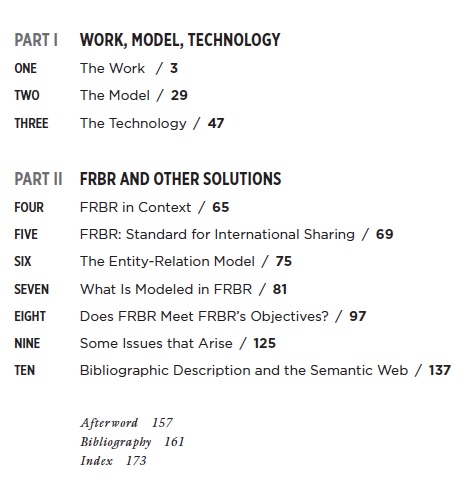
This is to announce the publication of my book, FRBR, Before and After, by ALA Editions, available in November, 2015. As is often the case, the title doesn't tell the story, so I want to give a bit of an introduction before everyone goes: "Oh, another book on FRBR, yeeech." To be honest, the book does have quite a bit about FRBR, but it's also a think piece about bibliographic models, and a book entitled "Bibliographic Models" would look even more boring than one called "FRBR, Before and After."

The before part is a look at the evolution of the concept of Work, and, yes, Panizzi and Cutter are included, as are Lubetzky, Wilson, and others. Then I look at modeling and how goals and models are connected, and the effect that technology has (and has not) had on library data. The second part of the book focuses on the change that FRBR has wrought both in our thinking and in how we model the bibliographic description. I'll post more about that in the near future, but let me just say that you might be surprised at what you read there.


The text will also be available as open access in early 2016. This is thanks to the generosity of ALA Editions, who agreed to this model. I do hope that enough libraries and individuals do decide to purchase the hard copy that ALA Publishing puts out so that this model of print plus OA is economically viable. I can attest to the fact that the editorial work and application of design to the book has produced a final version that I could not have even approximated on my own

Friday, July 17, 2015

Flexibility in bibliographic models

A motley crew of folks had a chat via Google Hangout earlier this week to talk about FRBR and Fedora. I know exactly squat about Fedora, but I've just spent 18 months studying FRBR and other bibliographic models, so I joined the discussion. We came to a kind of nodding agreement, that I will try to express here, but one that requires us to do some hard work if we are to make it something we can work with.

The primary conclusion was that the models of FRBR and BIBFRAME, with their separation of bibliographic information into distinct entities, are too inflexible for general use. There are simply too many situations in which either the nature of the materials or the available metadata simply does not fit into the entity boundaries defined in those models. This is not news -- since the publication of FRBR in 1998 there are have numerous articles pointing out the need for modifications of FRBR for different materials (music, archival materials, serials, and others). The report of the audio-visual community to BIBFRAME said the same. Similar criticisms have been aimed at recent generations of cataloging rules, whose goal is to provide uniformity in bibliographic description across all media types. The differences in treatment that are needed by the various communities are not mutually compatible, which means that a single model is not going to work over the vast landscape that is "cultural heritage materials."

At the same time, folks in this week's informal discussion were able to readily cite use cases in which they would want to identify a group of metadata statements that would define a particular aspect of the data, such as a work or an item. The trick, therefore, is to find a sweet spot between the need for useful semantics and the need for flexibility within the heterogeneous cultural heritage collections that could benefit from sharing and linking their data amongst them.

One immediate thought is: let's define a core! (OK, it's been done, but maybe that's a different core.) The problem with this idea is that there are NO descriptive elements that will be useful for all materials. Title? (seems obvious) -- but there are many materials in museums and archives that have no title, from untitled art works, to museum pieces ("Greek vase",) to materials in archives ("Letter from John to Mary"). Although these are often given names of a sort, none have titles that function to identify them in any meaningful way. Creators? From anonymous writings to those Greek vases, not to mention the dinosaur bones and geodes in a science museum, many things don't have identifiable creators. Subjects? Well, if you mean this to be "topic" then again, not everything has a topic; think "abstract art" and again those geodes. Most things have a genre or a type but standardizing on those alone would hardly reap great benefits in data sharing.

The upshot, at least the conclusion that I reach, is that there are no universals. At best there is some overlap between (A & B) and then between (B & C), etc. What the informal group that met this week concluded is that there is some value in standardizing among like data types, simply to make the job of developers easier. The main requirement overall, though, is to have a standard way to share ones metadata choices, not unlike an XML schema, but for the RDF world. Something that others can refer to or, even better, use directly in processing data you provide.

Note that none of the above means throwing over FRBR, BIBFRAME, or RDA entirely. Each has defined some data elements that will be useful, and it is always better to re-use than to re-invent. But the attempts to use these vocabularies to fix a single view of bibliographic data is simply not going to work in a world as varied as the one we live in. We limit ourselves greatly if we reject data that does not conform to a single definition rather than making use of connections between close but not identical data communities.

There's no solution being offered at this time, but identifying the target is a good first step.