Showing posts with label cataloging. Show all posts

Monday, June 27, 2022

The OCLC v Clarivate Dilemma

OCLC has filed suit against the company Clarivate which owns Proquest and ExLibris. The suit focuses on a metadata service proposed by Ex Libris called "MetaDoor." MetaDoor isn't a bibliographic database à la WorldCat, it is a peer-to-peer service that allows its users to find quality records in the catalog systems of other libraries. ("MetaDoor" is a terrible name for a product, by the way.)

What seems to specifically have OCLC's dander up is that Ex Libris states that it will allow any and all libraries, not just its Alma customers, to use this service for free. As the service does not yet exist it is unknown how it could affect the library metadata sharing environment. It may succeed, it may fail. If it succeeds, the technology that Ex Libris develops will be a logical next step in bibliographic data sharing, but its effect on OCLC is hard to predict.

Yesterday's and Today's Technology

WorldCat is yesterday's technology: a huge, centralized database. Peer-to-peer sharing of bibliographic records has been available since the 1980's with the development of the Z39.50 protocol, and presumably a considerable amount of sharing over that protocol has been used by libraries to obtain records from other libraries. Over the years many programs and systems have been developed to make use of Z39.50 and the protocol is built in to library systems, both for obtaining records and for sharing records.

The actual extent of peer-to-peer sharing of bibliographic records already today does not seem to be known, although I did only a brief amount of research looking for that information. It is definitely in use in library environments where participation in OCLC is unaffordable; articles vaunt its use in Russia, India, Korea, and other countries. It is built into the open source library system Koha that is aimed at those libraries that are priced out of the mainstream library systems market. Where libraries have known peers, such as the national library of a country, peer-to-peer makes good sense.

What OCLC's centralized database has that peer-to-peer lacks (at least to date) is consolidated library holdings information. As Kyle Banerjee said on Twitter, the real value in WorldCat is the holdings. This is used by interlibrary loan systems, and it is what appears on the screen when you do a WorldCat search. Cleverly, OCLC has recorded the geographical location of all of its holding libraries and can give you a list of libraries relative to your location. In the past this type of service was only available through a central database, but we may have arrived at point where peer-to-peer could provide this as well.

A couple of other things before I look at some specific points in the lawsuit. One is that WorldCat is not the only bibliographic database used for sharing of metadata. Some smaller library companies also have their own shared databases. These are much smaller than WorldCat and the libraries that use them generally are 1) unable to afford OCLC's member fees and 2) do not have need of the depth or breadth of WorldCat's bibliographic data. For example, the CARL database from TLC company has a database of 77 million records, many less than worldCat's over 500 million.  Even the Library of Congress catalog is only 20 million strong. The value for some libraries is that WorldCat contains the long tail; for others, that long tail is not needed. It's the difference between the Harvard library and your local public library. Harvard may well have need for metadata for a Lithuanian poetry journal, your local public library can do just fine with a peer database of popular works published in the US.

And another: we're slowly moving to a less "thing"-based world to a "data"-based world. Yes, scholars still need books and journals, but increasingly our information seeking returns tiny bites, not big thoughts. You can rue that, but I think it's only going to get worse. It's like the difference between a Ken Burns 10-part documentary on the Civil War and TikTok. The metadata creation activity for the deep thoughts of books and articles is not viable for YouTube, Instagram, TikTok or even Facebook. Us "book people" are hanging on to a vast repository that is less and less looking forward and more and more becoming dusty and crusty. We don't want to lose that valuable archive, but it is hard to claim that we are not a fading culture.

OK, to the lawsuit.

What is the Nut of this Case?

OCLC claims in its suit that Clarivate is undertaking MetaDoor as a malicious act, targeting WorldCat with a desire to destroy it. I don't think you need to be malicious to come up with a project to create an efficient system for sharing bibliographic records. Creating a shared database at this time is simply a logical need for any data service. 

The main fact behind OCLC's suit is that uploading library catalog bibliographic records to MetaDoor is a violation of the libraries' contracts with OCLC, and that Clarivate/Ex Libris is encouraging libraries to violate their contracts. As Clarivate has no such contract with OCLC, the suit uses terms like "conspiracy" and a lot of "tortious" to describe that Clarivate/Ex Libris is breaking some law of competition by encouraging OCLC customers to violate their contracts. 

I'm not sure how that will play in court but you can see on the Clarivate site that one of their main areas of expertise is in intellectual property around data. Regardless of the outcome of this suit we may get to see some interesting arguments around data ownership. It's still a wide-open area where some smart discussion would be very welcome.

The ILS Market

The lawsuit complains that Clarivate has become the largest player in the ILS market through its purchase of systems like Ex Libris and ProQuest. (It isn't clear to me how "large" is defined here.) It also bemoans the consolidation of the library market. The library market is hardly unique in this; consolidation of this type is a normal course of things in our barely-regulated capitalism. It is, as always, hard to understand just what Clarivate owns because Clarivate owns Proquest which owns Ex Libris which owns Innovative Interfaces which owns SkyRiver and VTLS, among others. The number of players in the library market, which once was a handful of independent companies, is shrinking at a rapid rate, and this has been a worry in the library world now for decades.

On its web site Clarivate presents itself as a research data and analytics company. It includes Proquest and Web of Science in its list of offerings, but interestingly makes no mention of Ex Libris. I've always wondered why anyone with any business sense would want to enter the library cataloging systems market. In fact, Clarivate inherited Ex Libris when it purchased Proquest, and the Clarivate press release upon acquiring Proquest makes no mention of Ex Libris or other library systems.

Speaking of market consolidation, one must remember that at one time OCLC had two rather large competitors in the library cataloging market: the Western Library Network and Research Libraries Information Network. OCLC purchased both of these, and they then ceased to exist. That was itself a consolidation that concerned many because at the time few library cataloging systems provided a significantly large database to support the cataloging activity. Also, take a gander at this chart from Marshall Breeding's Library Tech Guides that shows the "mergers and acquisitions" of OCLC:
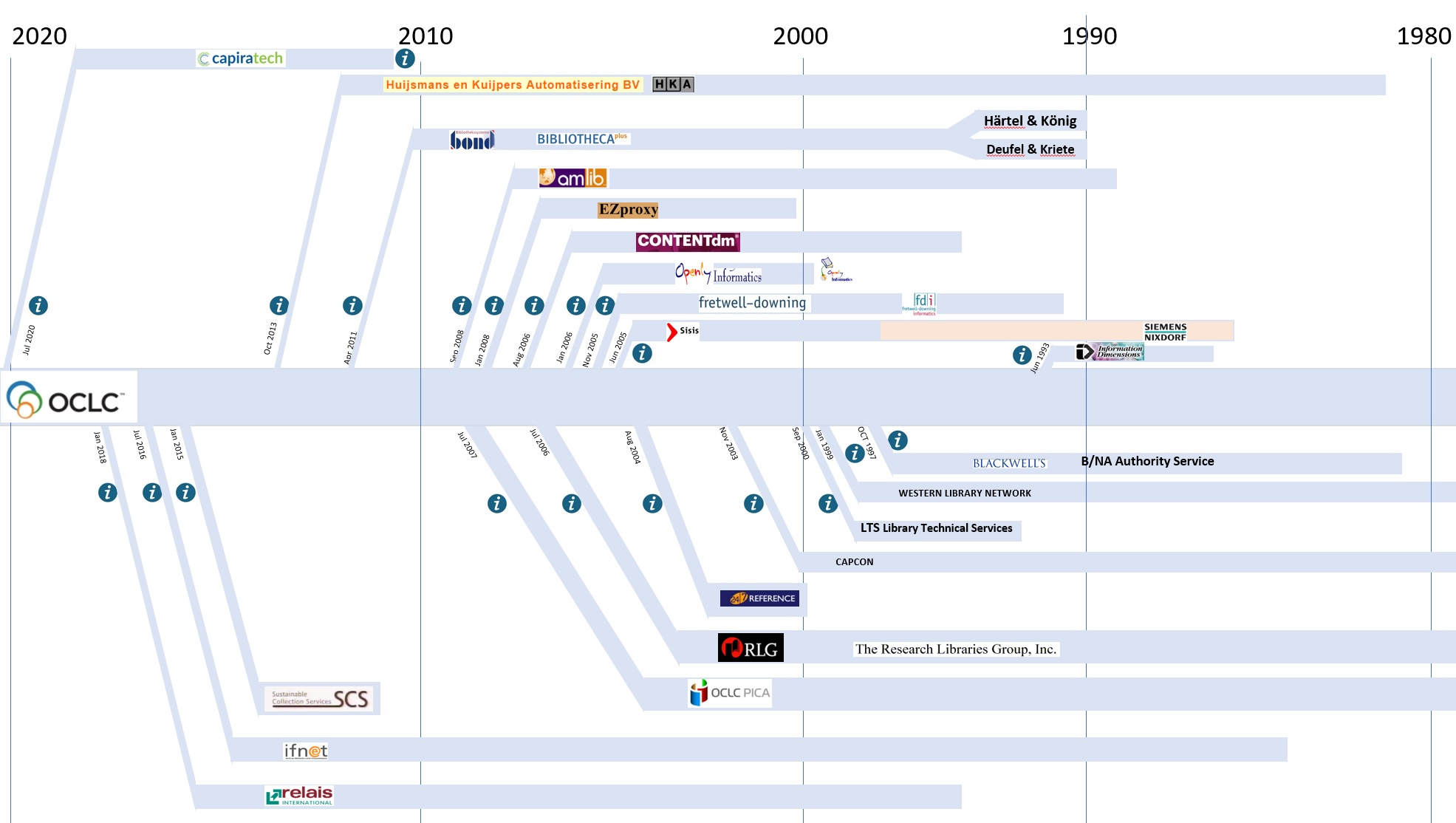

(more readable on Marshall's site, so hop over there fore details)

What is a WorldCat record?

The lawsuit speaks of the "theft" of WorldCat records by Ex Libris for their MetaDoor product (which isn't well explained as the records will be voluntarily offered by the participating libraries). The peer-to-peer action of MetaDoor, however, does not touch the WorldCat database directly. As I understand it from the Ex Libris web site, libraries using the Ex Libris system agree to have that system harvest records from their database. Information from those records will be indexed in MetaDoor but the records themselves will not stored there. Users of MetaDoor will discover records they need for cataloging through MetaDoor, and the records will be retrieved from the library system holding the record. Without a doubt, some of those records will have been downloaded by libraries during cataloging on OCLC. The lawsuit refers to these as "WorldCat records."

Here's the hitch: these are records are distributed among individual library databases. Each MARC record is a character string in which any part of that string can be modified using software written for that purpose. That software may be part of the library catalog system, or it may be standalone software like the open software MARCedit. Other software, like Open Refine, has been incorporated into batch workflows for MARC records to make changes to records. Basically, the records undergo a lot of changes, both the "enhancements" in WorldCat that the lawsuit refers to but also an unknown quantity of modifications once individual libraries obtain them.

Note that some libraries do not use OCLC and therefore have no WorldCat records, and many libraries have multiple sources of bibliographic data. It simply isn't possible to say "all your MARC belong to us." It's much more complicated than that. Although there is nominally both provenance and versioning data in the MARC records, these fields are as editable as all others. In addition, some systems ignore these and do not attempt to update those details as the records are edited. This means that there is no way to look at a record in a library database and determine precisely from where it was originally obtained prior to being in that database. If library A uses OCLC to create a catalog record and library B (not an OCLC cataloging customer) uses its catalog system's Z39.50 option to copy that record from Library A, modifying the record for its own purposes, then library C obtains the record from Library B ... well, you see the problem. These records may flow throughout the library catalog universe, losing their identity as WorldCat records with each step.

OCLC appears to claim in its suit that the OCLC number confers some kind of ownership stamp on the records. In one of the later paragraphs of a very insightful Scholarly Kitchen blog post, Todd Carpenter reminds us that OCLC has not claimed restrictions on the identification number. Also, like everything else in the MARC record, that number can be deleted, modified, or added to a record at the whim of the cataloger. (OK, I admit that "whim" and "cataloger" probably shouldn't be used in the same sentence.) 

Rather than flinging lawsuits around, it would be very interesting to use that money to hire one of those people who looks out 20 years to tell you what the environment will be and what you should be investing in today. I can cover a certain amount of the past, but the future is a fog to me. I hope someone has ideas.

-----

As with many lawsuits, there's a lot of flinging documentation back and forth. Check out this site to keep an eye on things. I welcome recommendations of other resources.

Tuesday, August 14, 2018

Libraryland, We Have a Problem


The first rule of every multi-step program is to admit that you have a problem. I think it's time for us librarians to take step one and admit that we do have a problem.

The particular problem that I have in mind is the disconnect between library data and library systems in relation to the category of metadata that libraries call "headings." Headings are the strings in the library data that represent those entities that would be entry points in a linear catalog like a card catalog.

It pains me whenever I am an observer to cataloger discussions on the proper formation of headings for items that they are cataloging. The pain point is that I know that the value of those headings is completely lost in the library systems of today, and therefore there are countless hours of skilled cataloger time that are being wasted.

The Heading


Both book and card catalogs were catalogs of headings. The catalog entry was a heading followed by one or more bibliographic entries. Unfortunately, the headings serve multiple purposes, which is generally not a good data practice but is due to the need for parsimony in library data when that data was analog, as in book and card catalogs.

  • A heading is a unique character string for the "thing" – the person, the corporate body, the family – essentially an identifier.
Tolkien, J. R. R. (John Ronald Reuel), 1892-1973
  • It supports the selection of the entity in the catalog from among the choices that are presented (although in some cases the effectiveness of this is questionable)


  • It is an access point, intended to be the means of finding, within the catalog, those items held by the library that meet the need of the user.
  • It provides the sort order for the catalog entries (which is why you see inverted forms like "Tolkien, J. R. R.")
United States. Department of State. Bureau for Refugee Programs
United States. Department of State. Bureau of Administration
United States. Department of State. Bureau of Administration and Security
United States. Department of State. Bureau of African Affairs
    • That sort order, and those inverted headings, also have a purpose of collocation of entries by some measure of "likeness"
    Tolkien, J. R. R. (John Ronald Reuel), 1892-1973
    Tolkien Society
    Tolkien Trust
    The last three functions, providing a sort order, access, and collocation, have been lost in the online catalog. The reasons for this are many, but the main explanation is that keyword searching has replaced alphabetical browse as a way to locate items in a library catalog.

    The upshot is that many hours are spent during the cataloging process to formulate a left-anchored, alphabetically order-able heading that has no functionality in library catalogs other than as fodder for a context-less keyword search.

    Once a keyword search is done the resulting items are retrieved without any correlation to headings. It may not even be clear which headings one would use to create a useful order. The set of retrieved bibliographic resources from a single keyword search may not provide a coherent knowledge graph. Here's an illustration using the keyword "darwin":

    Gardiner, Anne.
    Melding of two spirits : from the "Yiminga" of the Tiwi to the "Yiminga" of Christianity / by Anne Gardiner ; art work by
    Darwin : State Library of the Northern Territory, 1993.
    Christianity--Australia--Northern Territory.
    Tiwi (Australian people)--Religion.
    Northern Territory--Religion.

    Crabb, William Darwin.
    Lyrics of the golden west. By W. D. Crabb.
    San Francisco, The Whitaker & Ray company, 1898
    West (U.S.)--Poetry.

    Darwin, Charles, 1809-1882.
    Origin of species by means of natural selection; or, The preservation of favored races in the struggle for life and The descent of man and selection in relation to sex, by Charles Darwin.
    New York, The Modern library [1936]
    Evolution (Biology)
    Natural selection.
    Heredity.
    Human evolution.

    Bear, Greg, 1951-
    Darwin's radio / Greg Bear.
    New York : Ballantine Books, 2003.
    Women molecular biologists--Fiction.
    DNA viruses--Fiction.

    No matter what you would choose as a heading on which to order these, it will not produce a sensible collocation that would give users some context to understand the meaning of this particular set of items – and that is because there is no meaning to this set of items, just a coincidence of things named "Darwin."

    Headings that have been chosen to be controlled strings should offer a more predictable user search experience than free text searching, but headings do not necessarily provide collocation. As an example, Wikipedia uses the names of its pages as headings, and there are some rules (or at least preferred practices) to make the headings sensible. A search in Wikipedia is a left-to-right search on a heading string that is presented as a drop-down list of a handful of headings that match the search string:


    Included in the headings in the drop-down are "see"-type terms that, when selected, take the user directly to the entry for the preferred term. If there is no one preferred term Wikipedia directs users to disambiguation pages to help users select among similar headings:


    The Wikipedia pages, however, only provide accidental collocation, not the more comprehensive collocation that libraries aim to attain. That library-designed collocation, however, is also the source of the inversion of headings, making those strings unnatural and unintuitive for users. Although the library headings are admirably rules based, they often use rules that will not be known to many users of the catalog, such as the difference in name headings with prepositions based on the language of the author. To search on these names, one therefore needs to know the language of the author and the rule that is applied to that language, something that I am quite sure we can assume is not common knowledge among catalog users.

    De la Cruz, Melissa
    Cervantes Saavedra, Miguel de
    I may be the only patron of my small library branch that has known to look for the mysteries by Icelandic author Arnaldur Indriðason under "A" not "I".

    What Is To Be Done?


    There isn't an easy (or perhaps not even a hard) answer. As long as humans use words to describe their queries we will have the problem that words and concepts, and words and relationships between concepts, do not neatly coincide.

    I see a few techniques that might be used if we wish to save collocation by heading. One would be to allow keyword searching but for the system to use that to suggest headings that then can be used to view collocated works. Some systems do allow users to retrieve headings by keyword, but headings, which are very terse, are often not self-explanatory without the items they describe. A browse of headings alone is much less helpful that the association of the heading with the bibliographic data it describes. Remember that headings were developed for the card catalog where they were printed on the same card that carried the bibliographic description.

    Another possible area of investigation would be to look to the classified catalog, a technique that has existed alongside alphabetical catalogs for centuries. The Decimal Classification of Dewey was a classified approach to knowledge with a language-based index (his "Relativ Index") to the classes. (It is odd that the current practice in US libraries is to have one classification for items on shelves and an unrelated heading system (LCSH) for subject access.)
    The classification provides the intellectual collocation that the headings themselves do not provide. The difficulty with this is that the classification collocates topically but, at least in its current form, does not collocate the name headings in the catalog that identify people and organizations as entities.

    Conclusion (sort of)

    Controlled headings as access points for library catalogs could provide better service than keyword search alone. How to make use of headings is a difficult question. The first issue is how to exploit the precision of headings while still allowing users to search on any terms that they have in mind. Keyword search is, from the user's point of view, frictionless. They don't have to think "what string would the library have used for this?".

    Collocation of items by topical sameness or other relationships (e.g. "named for", "subordinate to") is possibly the best service that libraries could provide, although it is very hard to do this through the mechanism of language strings. Dewey's original idea of a classified order with a language-based index is still a good one, although classifications are hard to maintain and hard to assign.

    If challenged to state what I think the library catalog should be, my answer would be that it should provide a useful order that illustrates one or more intellectual contexts that will help the user enter and navigate what the library has to offer. Unfortunately I can't say today how we could do that. Could we think about that together?

    Readings

    Dewey, Melvil. Decimal classification and relativ index for libraries, clippings, notes, etc. Edition 7. Lake Placid Club, NY., Forest Press, 1911. https://archive.org/details/decimalclassifi00dewegoog

    Shera, Jesse H, Margaret E. Egan, and Jeannette M. Lynn. The Classified Catalog: Basic Principles and Practices. Chicago, Ill: American Library Association, 1956


    Monday, August 06, 2018

    FRBR as a Data Model


    (I've been railing against FRBR since it was first introduced. It still confuses me some. I put out these ideas for discussion. If you disagree, please add your thoughts to this post.)

    I was recently speaking at a library conference in OSLO where I went through my criticisms of our cataloging models, and how they are not suited to the problems we need to solve today. I had my usual strong criticisms of FRBR and the IFLA LRM. However, when I finished speaking I was asked why I am so critical of those models, which means that I did not explain myself well. I am going to try again here, as clearly and succinctly as I can.

    Conflation of Conceptual Models with Data Models


    FRBR's main impact was that it provided a mental model of the bibliographic universe that reflects a conceptual view of the elements of descriptive cataloging. You will find nothing in FRBR that could not be found in standard library cataloging of the 1990's, which is when the FRBR model was developed. What FRBR adds to our understanding of bibliographic information is that it gives names and definitions to key concepts that had been implied but not fully articulated in library catalog data. If it had stopped there we would have had an interesting mental model that allows us to speak more precisely about catalogs and cataloging.

    Unfortunately, the use of diagrams that appear to define actual data models and the listing of entities and their attributes have led the library world down the wrong path, that of reading FRBR as the definition of a physical data model. Compounding this, the LRM goes down that path even further by claiming to be a structural model of bibliographic data, which implies that it is the structure for library catalog data. I maintain that the FRBR conceptual model should not be assumed to also be a model for bibliographic data in a machine-readable form. The main reason for this has to do with the functionality that library catalogs currently provide (and and what functions they may provide in the future). This is especially true in relation to what FRBR refers to as its Group 1 entities: work, expression, manifestation, and item.

    The model defined in the FRBR document presents an idealized view that does not reflect the functionality of bibliographic data in library catalogs nor likely system design. This is particularly obvious in the struggle to fit the reality of aggregate works into the Group 1 "structure," but it is true even for simple published resources. The remainder of this document attempts to explain the differences between the ideal and the real.

    The Catalog vs the Universe


    One of the unspoken assumptions in the FRBR document is that it poses its problems and solutions in the context of the larger bibliographic universe, not in terms of a library catalog. The idea of gathering all of the manifestations of an expression and all of the expressions of a work is not shown as contingent on the holdings of any particular library. Similarly, bibliographic relationships are presented as having an existence without addressing how those relationships would be handled when the related works are not available in a data set. This may be due to the fact that the FRBR working group was made up solely of representatives of large research libraries whose individual catalogs cover a significant swath of the bibliographic world. It may also have arisen from the fact that the FRBR working group was formed to address the exchange of data between national libraries, and thus was intended as a universal model. Note that no systems designers were involved in the development of FRBR to address issues that would come up in catalogs of various extents or types.

    The questions asked and answered by the working group were therefore not of the nature of "how would this work in a catalog?" and were more of the type "what is nature of bibliographic data?". The latter is a perfectly legitimate question for a study of the nature of bibliographic data, but that study cannot be assumed to answer the first question.

    Functionality


    Although the F in FRBR stands for "functional" FRBR does little to address the functionality of the library catalog. The user tasks find, identify, select and obtain (and now explore, added in the LRM) are not explained in terms of how the data aids those tasks; the FRBR document only lists which data elements are essential to each task. Computer system design, including the design of data structures, needs to go at least a step further in its definition of functions, which means not only which data elements are relevant, but the specific usage the data element is put to in an actual machine interaction with the user and services. A systems developer has to take into account precisely what needs to be done with the FRBR entities in all of the system functions, from input to search and display.

    (Note: I'm going to try to cover this better and to give examples in an upcoming post.)

    Analysis that is aimed at creating a bibliographic data format for a library catalog would take into account that providing user-facing information about work and expression is context-dependent based on the holdings of the individual library and on the needs of its users. It would also take into account the optional use of work and expression information in search and display, and possibly give alternate views to support different choices in catalog creation and deployment. Essentially, analysis for a catalog would take system functionality into account.

    There a lot of facts about the nature of computer-based catalogs have to be acknowledged: that users are no longer performing “find” in an alphabetical list of headings, but are performing keyword searches; that collocation based on work-ness is not a primary function of catalog displays; that a significant proportion of a bibliographic database consists of items with a single work-expression-manifestation grouping; and finally that there is an inconsistent application of work and expression information in today's data.

    In spite of nearly forty years of using library systems whose default search function is a single box in which users are asked to input query terms that will be searched as keywords taken from a combination of creator, title, and subject fields in the bibliographic record, the LRM doubles down on the status of textual headings as primary elements, aka: Nomen. Unfortunately it doesn't address the search function in any reasonable fashion, which is to say it doesn't give an indication of the role of Nomen in the find function. In fact, here is the sum total of what the LRM says about search:

    "To facilitate this task [find], the information system seeks to enable effective searching by offering appropriate search elements or functionality."


    That's all. As I said in my talk at Oslo, this is up there with the jokes about bad corporate mission statements, like: "We endeavor to enhance future value through intelligent paradigm implementation." First, no information system ineffective searching. Yet the phrase "effective searching" is meaningless in itself; without a definition of what is effective this is just a platitude. The same is true for "appropriate search elements": no one would suggest that a system should use inappropriate search elements, but defining appropriate search is not at all a simple task. In fact, I contend that one of the primary problems with today's library systems is that we specifically lack a definition of appropriate, effective search. This is rendered especially difficult because the data that we enter into our library systems is data that was designed for an entirely different technology: the physical card catalog, organized as headings in alphabetical order.

    One Record to Rule Them All


    Our actual experience regarding physical structures for bibliographic data should be sufficient proof that there is not one single solution. Although libraries today are consolidating around the MARC21 record format, primarily for economic reasons, there have been numerous physical formats in use that mostly adhere to the international standard of ISBD. In this same way, there can be multiple physical formats that adhere to the conceptual model expressed in the FRBR and LRM documents. We know this is the case by looking at the current bibliographic data, which includes varieties of MARC, ISBD, BIBFRAME, and others. Another option for surfacing information about works in catalogs could follow what OCLC seems to be developing, which is the creation of works through a clustering of single-entity records. In that model, a work is a cluster of expressions, and an expression is a cluster of manifestations. This model has the advantage that it does not require the cataloger to make decisions about work and expression statements before it is known if the resource will be the progenitor of a bibliographic family, or will stand alone. It also does not require the cataloger to have knowledge of the bibliographic universe beyond their own catalog.

    The key element of all of these, and countless other, solutions is that they can be faithful to the mental model of FRBR while also being functional and efficient as systems. We should also expect that the systems solutions to this problem space will not stay the same over time, since technology is in constant evolution.

    Summary


    I have identified here two quite fundamental areas where FRBR's analysis differs from the needs of system development: 1) the difference between conceptual and physical models and 2) the difference between the (theoretical) bibliographic universe and the functional library catalog. Neither of these are a criticism of FRBR as such, but they do serve as warnings about some widely held assumptions in the library world today, which is that of mistaking the FRBR entity model for a data and catalog design model. This is evident in the outcry over the design of the BIBFRAME model which uses a two-tiered bibliographic view and not the three-tiers of FRBR. The irony of that complaint is that at the very same time as those outcries, catalogers are using FRBR concepts (as embodied in RDA) while cataloging into the one-tiered data model of MARC, which includes all of the entities of FRBR in a single data record. While cataloging into MARC records may not be the best version of bibliographic data storage that we could come up with, we must acknowledge that there are many possible technology solutions that could allow the exercise of bibliographic control while making use of the concepts addressed in FRBR/LRM. Those solutions must be based as least as much on user needs in actual catalogs as on bibliographic theory.

    As a theory, FRBR posits an ideal bibliographic environment which is not the same as the one that is embodied in any library catalog. The diagrams in the FRBR and LRM documents show the structure of the mental model, but not library catalog data. Because the FRBR document does not address implementation of the model in a catalog, there is no test of how such a model does or does not reflect actual system design. The extrapolation from mental model to physical model is not provided in FRBR or the LRM, as neither addresses system functions and design, not even at a macro level.

    I have to wonder if FRBR/LRM shouldn't be considered a model for bibliography rather than library catalogs. Bibliography was once a common art in the world of letters but that has faded greatly over the last half century. Bibliography is not the same as catalog creation, but one could argue that libraries and librarians are the logical successors to the bibliographers of the past, and that a “universal bibliography” created under the auspices of libraries would provide an ideal context for the entries in the library catalog. This could allow users to view the offerings of a single library as a subset of a well-described world of resources, most of which can be accessed in other libraries and archives.
    ­


    Sunday, July 09, 2017

    The Work

    I've been on a committee that was tasked by the Program for Cooperative Cataloging folks(*) to help them understand some of the issues around works (as defined in FRBR, RDA, BIBFRAME, etc.). There are huge complications, not the least being that we all are hard-pressed to define what a work is, much less how it should be addressed in some as-yes-unrealized future library system. Some of what I've come to understand may be obvious to you, especially if you are a cataloger who provides authority data for your own catalog or the shared environment. Still, I thought it would be good to capture these thoughts. Of course, I welcome comments and further insights on this.


    There are at least four different meanings to the term work as it is being discussed in library venues.

    "Work-ness"

    First there is the concept that every resource embodies something that could be called a "work" and that this work is a human creation. The idea of the work probably dates back as far as the recognition that humans create things, and that those things have meaning. There is no doubt that there is "work-ness" in all created things, although prior to FRBR there was little attempt to formally define it as an aspect of bibliographic description. It entered into cataloging consciousness in the 20th century: Patrick Wilson saw works as families of resources that grow and branch with each related publication;[1] Richard Smiraglia looked at works as a function of time;[2] and Seymour Lubetzky seems to have been the first to insist on viewing the work as intellectual content separate from the physical piece.[3]

    "Work Description"

    Second, there is the work in the bibliographic description: the RDA cataloging rules define the attributes or data elements that make up the work description, like the names of creators and the subject matter of the resource. Catalogers include these elements in descriptive cataloging even when the work is not defined as a stand-alone entity, as in the case of doing RDA cataloging in a MARC21 record environment. Most of the description of works is not new; creators and subjects have been assigned to cataloged items for a century or more. What is changed is that conceptually these are considered to be elements of the work that is inherent in the resource that is being cataloged but not limited to the item in hand.

    It is this work description that is addressed in FRBR. The FRBR document of 1998 describes the scope of its entities to be solely bibliographic,  specifically excluding authority data:
    "The present study does not analyse those additional data associated with persons, corporate bodies, works, and subjects that are typically recorded only in authority records."
    Notably, FRBR is silent on the question of whether the work description is unique within the catalog, which would be implied by the creation of a work authority "record".

    "Work Decision"

    Next there is the work decision: this is the situation when a data creator determines whether the work to be described needs a unique and unifying entry within the stated cataloging environment to bring together exemplars of the same work that may be described differently. If so, the cataloger defines the authoritative identity for the work and provides information that distinguishes that work from all other works, and that brings together all of the variations of that work. The headings ("uniform titles") that are created also serve to disambiguate expressions of the same work by adding dates, languages, and other elements of the expression. To back all of this up, the cataloger gives evidence of his/her decision, primarily what sources were consulted that support the decision.

    In today's catalog, a full work decision, resulting in a work authority record, is done for only a small number of works, with the exception of musical works where such titles are created for nearly all. The need to make the work decision may vary from catalog to catalog and can depend on whether the library holds multiple expressions of the work or other works that may need clarification in the catalog. Note that there is nothing in FRBR that would indicate that every work must have a unique description, just that works should be described. However, some have assumed that the FRBR work is always a representation of a unique creation. I don't find that expressed in FRBR nor the FRBR-LRM.

    "Work Entity"

    Finally there is the work entity: this is a data structure that encapsulates the description of the work. This data structure could be realized in any number of different encodings, such as ISO 2709 (the underlying record structure for MARC21), RDF, XML, or JSON. The latter two can also accommodate linked data in the form of RDFXML or JSON-LD.

    Here we have a complication in our current environment because the main encodings of bibliographic data, MARC21 and BIBFRAME, both differ from the work concept presented in FRBR and in the RDA cataloging rules, which follow FRBR fairly faithfully. With a few exceptions, MARC21 does not distinguish work elements from expression or manifestation elements. Encoding RDA-defined data in the MARC21 "unit record" can be seen as proof of the conceptual nature of the work (and expression and manifestation) as defined in FRBR.

    BIBFRAME, the proposed replacement for MARC21, has re-imagined the bibliographic work entity, departing from the entity breakdown in FRBR by defining a BIBFRAME work entity that tends to combine elements from FRBR's work and expression. However, where FRBR claims a neat divison between the entities, with no overlapping descriptive elements, BIBFRAME 2.0 is being designed as a general bibliographic model, not an implementation of FRBR. (Whether or not BIBFRAME achieves this goal is another question.)

    The diagrams in the 1998 FRBR report imply that there would be a work entity structure. However, the report also states unequivocally that it is not defining a data format.(**) In keeping with 1990's library technology, FRBR anticipates that each entity may have an identifier, but the identifier is a descriptive element (think: ISBN), not an anchor for all of the data elements of the entity (think: IRI).

    As we see with the implementation of RDA cataloging in the MARC21 environment, describing a work conceptually does not require the use of a separate work "record." Whether work decisions are required for every cataloged manifestation is a cataloging decision; whether work entities are required for every work is a data design decision. That design decision should be based on the services that the system is expected to render.  The "entity" decision may or may not require any action on the part of the cataloger depending on the interface in which cataloging takes place. Just as today's systems do not store the MARC21 data as it appears on the cataloger's screen, future systems will have internal data storage formats that will surely differ from the view in the various user interfaces.

    "The Upshot"

    We can assume that every human-created resource has an aspect of work-ness, but this doesn't always translate well to bibliographic description nor to a work entity in bibliographic data. Past practice in relation to works differs significantly from, say, the practice in relation to agents (persons, corporate bodies) for whom one presumes that the name authority control decision is always part of the cataloging workflow. Instead, work "names" have been inconsistently developed (with exceptions, such as in music materials). It is unclear if, in the future, every work description will be assumed to have undergone a "work name authority" analysis, but even more unreliable is any assumption that can be made about whether an existing bibliographic description without a uniform title has had its "work-ness" fully examined.

    This latter concern is especially evident in the transformations of current MARC21 cataloging into either RDA, BIBFRAME, or schema.org. From what I have observed, the transformations do not preserve the difference between a manifestation title that does not have a formal uniform title to represent the work, and those titles that are currently coded in MARC21 fields 130, 240, or the $t of an author/title field. Instead, where a coded uniform title is not available in the MARC21 record, the manifestation title is copied to the work title element. This means that the fact that a cataloger has carefully crafted a work title for the resource is lost. Even though we may agree that the creation of work titles has been inconsistent at best, copying transcribed titles to the work title entity wherever no uniform title field is present in the MARC21 record seems to be a serious loss of information. Or perhaps I should put this as a question: in the absence of a unform title element, can we assume that the transcribed title is the appropriate work title?

    To conclude, I guess I will go ahead and harp on a common nag of mine, which is that copying data from one serialization to another is not the transformation that will help us move forward. The "work" is very complex; I would feel less concerned if we had a strong and shared concept of what services we want the work to provide in the future, which should help us decide what to do with the messy legacy that we have today.


    Footnotes

    * Note that in 1877 there already was a "Co-operation committee" of the American Library Association, tasked with looking at cooperative cataloging and other tasks. That makes this a 140-year-old tradition.
    "Of the standing committees, that on co-operation will probably prove the most important organ of the Association..." (see more at link)

    ** If you want more about what FRBR is and is not, I will recommend my book "FRBR: Before and After" (open access copy) for an in-depth analysis. If you want less, try my SWIB talk "Mistakes Have Been Made" which gets into FRBR at about 13:00, but you might enjoy the lead-up to that section.

    References

    [1] Wilson, Patrick. Two Kinds of Power : an Essay on Bibliographical Control. University of California Publications: Librarianship. Berkeley, Los Angeles, London: University of California Press, 1978.
    [2] Smiraglia, Richard. The Nature of “a Work”; Implications for the Organization of Knowledge. Lanham: Scarecrow Press, 2001.
    [3] Lubetzky, Seymour. Principles of Cataloging. Final report. Phase I. In: Seymour Lubtezky: writings on the classical art of cataloging. Edited by Elaine Svenonius and Dorothy McGarry. Englewood, CO, Libraries Unlimited. 2001

    Wednesday, April 12, 2017

    If It Ain't Broke

    For the first time in over forty years there is serious talk of a new metadata format for library bibliographic data. This is an important moment.

    There is not, however, a consensus within the profession on the need to replace the long-standing MARC record format with something different. A common reply to the suggestion that library data creation needs a new data schema is the phrase: "If it ain't broke, don't fix it." This is more likely to be uttered by members of the cataloging community - those who create the bibliographic data that makes up library catalogs - than by those whose jobs entail systems design and maintenance. It is worth taking a good look at the relationship that catalogers have with the MARC format, since their view is informed by decades of daily encounters with a screen of MARC encoding.

    Why This Matters

    When the MARC format was developed, its purpose was clear: it needed to provide the data that would be printed on catalog cards produced by the Library of Congress. Those cards had been printed for over six decades, so there was no lack of examples to use to define the desired outcome. In ways unimagined at the time, MARC would change, nay, expand the role of shared cataloging, and would provide the first online template for cataloging.

    Today work is being done on the post-MARC data schema. However, how the proposed new schema might change the daily work of catalogers is unclear. There is some anxiety in the cataloging community about this, and it is understandable. What I unfortunately see is a growing distrust of this development on the part of the data creators in our profession. It has not been made clear what their role is in the development of the next "MARC," not even whether their needs are a driving force in that development. Surely a new model cannot be successful without the consideration (or even better, the participation) of the people who will spend their days using the new data model to create the library's data.

    (An even larger question is the future of the catalog itself, but I hardly know where to begin on that one.)


    If it Ain't Broke...

    The push-back against proposed post-MARC data formats is often seen as a blanket rejection of change. Undoubtedly this is at times the case. However, given that there have now been multiple generations of catalogers who worked and continue to work with the MARC record, we must assume that the members of the cataloging community have in-depth knowledge of how that format serves the cataloging function. We should tap that knowledge as a way to understand the functionality in MARC that has had a positive impact on cataloging for four decades, and should study how that functionality could be carried forward into the future bibliographic metadata schema.

    I asked on Twitter for input on what catalogers like about MARC, and received some replies. I also viewed a small number of presentations by catalogers, primarily those about proposed replacements for MARC. From these I gathered the following list of "what catalogers like about MARC." I present these without comment or debate. I do not agree with all of the statements here, but that is no matter; the purpose here is to reflect cataloger perspectives.

    (Note: This list is undoubtedly incomplete and I welcome comments or emails with your suggestions for additions or changes.)


    What Catalogers Like/Love About MARC


    There is resistance to moving away from using the MARC record for cataloging among some in the Anglo-American cataloging community. That community has been creating cataloging data in the MARC formats for forty years. For these librarians, MARC has many positive qualities, and these are qualities that are not perceived to exist in the proposals for linked data. (Throughout the sections below, read "library cataloging" and variants as referring to the Anglo-American cataloging tradition that uses the MARC format and the Anglo-American Cataloging Rules and its newer forms.)

    MARC is Familiar

    Library cataloging makes use of a very complex set of rules that determine how a resource is described. Once the decisions are made regarding the content of the description, those results are coded in MARC. Because the creation of the catalog record has been done in the MARC format since the late 1970's, working catalogers today have known only MARC as the bibliographic record format and the cataloging interface. Catalogers speak in "MARC" - using the tags to name data elements - e.g. "245" instead of "title proper".

    MARC is WYSIWYG

    Those who work with MARC consider it to be "human readable." Most of the description is text, therefore what the cataloger creates is exactly what will appear on the screen in the library catalog. If a cataloger types "ill." that is what will display; if the cataloger instead types "illustrations" then that is what will display. In terms of viewing a MARC record on a screen, some cataloger displays show the tags and codes to one side, and the text of those elements is clearly readable as text.

    MARC Gives Catalogers Control

    The coding is visible, and therefore what the cataloger creates on the screen is virtually identical to the machine-readable record that is being created. Everything that will be shown in the catalog is in the record (with the exception of cover art, at least in some catalogs). The MARC rules say that the order of fields and subfields in the record are the order in which that information should be displayed in the catalog. Some systems violate this by putting the fields in numeric order, but the order of subfields is generally maintained. Catalogers wish to control the order of display and are frustrated when they cannot. In general, changing anything about the record with automated procedures can un-do the decisions made by catalogers as part of their work, and is a cause of frustration for catalogers.

    MARC is International

    MARC is used internationally, and because the record uses numerics and alphanumeric codes, a record created in another country is readable to other MARC users. Note that this was also the purpose of the International Standard Bibliographic Description (ISBD), which instead of tags uses punctuation marks to delimit elements of the bibliographic description. If a cataloger sees this, but cannot read the text:

      245 02   |a לטוס עם עין אחת / |c דני בז.

    it is still clear that this is a title field with a main title (no subtitle), followed by a statement of the author's name as provided on the title page of the book.

    MARC is the Lingua Franca of Cataloging

    This is probably the key point that comprises all of the above, but it is important to state it as such. This means that the entire workflow, the training materials, the documentation - all use MARC. Catalogers today think in MARC and communicate in MARC. This also means that MARC defines the library cataloging community in the way that a dialect defines the local residents of a region. There is pride in its "library-ness". It is also seen as expressing the Anglo-American cataloging tradition.

    MARC is Concise

    MARC is concise as a physical format (something that is less important today than it was in the 1960s when MARC was developed), and it is also concise on the screen. "245" represents "title proper"; "240" represents "uniform title"; "130" represents "uniform title main entry". Often an entire record can be viewed on a single screen, and the tags and subfield codes take up very little display space.

    MARC is Very Detailed

    MARC21 has about 200 tags currently defined, and each of these can have up to 36 subfields. There are about 2000 subfields defined in MARC21, although the distribution is uneven and depends on the semantics of the field; some fields have only a handful of subfields, and in others there are few codes remaining that could be assigned.

    MARC is Flat

    The MARC record is fairly flat, with only two levels of coding: field and subfield. This is a simple model that is easy to understand and easy to visualize.

    MARC is Extensible

    Throughout its history, the MARC record has been extended by adding new fields and subfields. There are about 200 defined fields which means that there is room to add approximately 600 more.

    MARC has Mnemonics

    Some coding is either consistent or mnemonic, which makes it easier for catalogers to remember the meaning of the codes. There are code blocks that refer to cataloging categories, such as the title block (2XX), the notes block (5XX) and the subject block (6XX). Some subfields have been reserved for particular functions, such as the use of the numeric subfields in 0-8. In other cases, the mnemonic is used in certain contexts, such as the use of subfield "v" for the volume information of series. In other fields, the "v" may be used for something else, such as the "form" subfield in subject fields, but the context makes it clear.

    There are also field mnemonics. For example, all tagged fields that have "00" in the second and third places are personal name fields. All fields and subfields that use the number 9 are locally defined (with a few well-known exceptions).

    MARC is Finite and Authoritative

    MARC defines a record that is bounded. What you see in the record is all of the information that is being provided about the item being described. The concept of "infinite graphs" is hard to grasp, and hard to display on a screen. This also means that MARC is an authoritative statement of the library bibliographic description, whereas graphs may lead users to sources that are not approved by or compatible with the library view.

    Thursday, April 06, 2017

    Precipitating Forward

    Our Legacy, Our Mistake


    If you follow the effort taking place around the proposed new bibliographic data standard, BIBFRAME, you may have noticed that much of what is being done with BIBFRAME today begins our current data in MARC format and converts it to BIBFRAME. While this is a function that will be needed should libraries move to a new data format, basing our development on how our legacy data converts is not the best way to move forward. In fact, it doesn't really tell us what "forward" might look like if we give it a chance.

    We cannot define our future by looking only at our past. There are some particular aspects of our legacy data that make this especially true.          

    I have said before (video, article) that we made a mistake when we went from printing cards using data encoded in MARC, to using MARC in online catalogs. The mistake was that we continued to use the same data that had been well-adapted to card catalogs without making the changes that would have made it well-adapted to computer catalogs. We never developed data that would be efficient in a database design or compatible with database technology. We never really moved from textual description to machine-actionable data points. Note especially that computer catalogs fail to make use of assigned headings as they are intended, yet catalogers continue to assign them at significant cost.

    One of the big problems in our legacy data that makes it hard to take advantage of computing technology is that the data tends to be quirky. Technology developers complain that the data is full of errors (as do catalogers), but in fact it is very hard to define, algorithmically, what is an error in our data.  The fact is that the creation of the data is not governed by machine rules; instead, decisions are made by humans with a large degree of freedom. Some fields are even defined as being either this or that, something that is never the case in a data design. A few fields are considered required, although we've all seen records that don't have those required fields. Many fields are repeatable and the order of fields and subfields is left to the cataloger, and can vary.

    The cataloger view is of a record of marked-up text. Computer systems can do little with text other than submit it for keyword indexing and display it on the screen. Technical designers look to the fixed fields for precise data points that they can operate on, but these are poorly supported and are often not included in the records since they don't look like "cataloging" as it is defined in libraries. These coded data elements are not defined by the cataloging code, either, and can be seen a mere "add-ons" that come with the MARC record format. The worst of it is that they are almost uniformly redundant with the textual data yet must be filled in separately, an extra step in the cataloging process that some cannot afford.

    The upshot of this is that it is very hard to operate over library catalog data algorithmically. It is also very difficult to do any efficient machine validation to enforce consistency in the data. If we carry that same data and those same practices over to a different metadata schema, it will still be very hard to operate over algorithmically, and it will still be hard to do quality control as a function of data creation.

    The counter argument to this is that cataloging is not a rote exercise - that catalogers must make complex decisions that could not be done by machines. If cataloging were subject to the kinds of data entry rules that are used in banking and medical and other modern systems, then the creativity of the cataloger's work would be lost, and the skill level of cataloging would drop to mere data entry.

    This is the same argument you could used for any artisanal activity. If we industrialize the act of making shoes, the skills of the master shoe-maker are lost. However, if we do not industrialize shoe production, only a very small number of people will be able to afford to wear shoes.

    This decision is a hard one, and I sympathize with the catalogers who are very proud of their understanding of the complexity of the bibliographic world. We need people who understand that complexity. Yet increasingly we are not able to afford to support the kind of cataloging practices of which we are proud. Ideally, we would find a way to channel those skills into a more efficient workflow.

    There is a story that I tell often: In the very early days of the MARC record, around the mid-1970's, many librarians thought that we could never have a "computer catalog" because most of our cataloging existed only on cards, and we could NEVER go back and convert the card catalogs, retype every card into MARC. At that same time, large libraries in the University of California system were running over 100,000-150,000 cards behind in their filing. For those of you who never filed cards... it was horribly labor intensive. Falling 150,000 cards behind meant that a book was on the shelf THREE MONTHS before the cards were in the catalog. Some of this was the "fault" of OCLC which was making it almost too easy to create those cards. Another factor was a great increase in publishing that was itself facilitated by word processing and computer-driven typography. Within less than a decade it became more economical to go through the process of conversion from printed cards to online catalogs than to continue to maintain enormous card catalogs. And the rest is history. MARC, via OCLC, created a filing crisis, and in a sense it was the cost of filing that killed the card catalog, not the thrill of the modern online catalog.

    The terrible mistake that we made back then was that we did not think about what was different between the card catalog and the online catalog, and we did not adjust our data creation accordingly. We carried the legacy data into the new format which was a disservice to both catalogers and catalog users. We missed an opportunity to provide new discovery options and more efficient data creation.

    We mustn't make this same mistake again.

    The Precipitant

    Above I said that libraries made the move into computer-based catalogs because it was uneconomical to maintain the card catalog. I don't know what the precipitant will be for our current catalog model, but there are some rather obvious places to look to for that straw that will break the MARC/ILS back. These problems will probably manifest themselves as costs that require the library to find a more efficient and less costly solution. Here are some of the problems that I see today that might be factors that require change:

    • Output rates of intellectual and cultural products is increasing. Libraries have already responded to this through shared cataloging and purchase of cataloging from product vendors. However, the records produced in this way are then loaded into thousands of individual catalogs in the MARC-using community.
    • Those records are often edited for correctness and enhanced. Thus they are costing individual libraries a large amount of money, potentially as much or more than libraries save by receiving the catalog copy.
    • Each library must pay for a vendor system that can ingest MARC records, facilitate cataloging, and provide full catalog user (patron) support for searching and display.
    • "Sharing" in today's environment means exporting data and sending it as a file. Since MARC records can only be shared as whole records, updates and changes generally are done as a "full record replace" which requires a fair amount of cycles. 
    • The "raw" MARC record as such is not database friendly, so records must be greatly massaged in order to store them in databases and provide indexing and displays. Another way to say this is that there are no database technologies that know about the MARC record format. There are database technologies that natively accept and manage other data formats, such as key-value pairs

    There are some current technologies that might provide solutions:

    • Open source. There is already use of open source technology in some library projects. Moving more toward open source would be facilitated by moving away from a library-centric data standard and using at least a data structure that is commonly deployed in the information technology world. Some of this advantage has already been obtained with using MARCXML.
    • The cloud. The repeated storing of the same data in thousands of catalogs means not being able to take advantage of true sharing. In a cloud solution, records would be stored once (or in a small number of mirrors), and a record enhancement would enhance the data for each participant without being downloaded to a separate system. This is similar to what is being proposed by OCLC's WorldShare and Ex Libris' Alma, although presumably those are "starter" applications. Use of the cloud for storage might also mean less churning of data in local databases; it could mean that systems could be smaller and more agile.
    • NoSQL databases and triple stores. The current batch of databases are open source, fast, and can natively process data in a variety of formats (although not MARC). Data does not have to be "pre-massaged" in order to be stored in a database or retrieved and the database technology and the data technology are in sync. This makes deployment of systems easier and faster. There are NoSQL database technologies for RDF. Another data format that has dedicated database technology is XML, although that ship may have sailed by now.
    • The web. The web itself is a powerful technology that retrieves distributed data at astonishing rates. There are potential cost/time savings on any function that can be pushed out the web to make use of its infrastructure. 

    The change from MARC to ?? will come and it will be forced upon us through technology and economics. We can jump to a new technology blindly, in a panic, or we can plan ahead. Duh.


    Monday, September 26, 2016

    2 Mysteries Solved!

    One of the disadvantages of a long tradition is that the reasons behind certain practices can be lost over time. This is definitely the case with many practices in libraries, and in particular in practices affecting the library catalog. In U.S. libraries we tend to date our cataloging practices back to Panizzi, in the 1830's, but I suspect that he was already building on practices that preceded him.

    A particular problem with this loss of history is that without the information about why a certain practice was chosen it becomes difficult to know if or when you can change the practice. This is compounded in libraries by the existence of entries in our catalogs that were created long before us and by colleagues whom we can no longer consult.


    I was recently reading through volume one of the American Library Journal from the year 1876-1877. The American Library Association had been founded in 1876 and had its first meeting in Philadelphia in September, 1876. U.S. librarianship finally had a focal point for professional development. From the initial conference there were a number of ALA committees working on problems of interest to the library community. A Committee on Cooperative Cataloguing, led by Melvil Dewey, (who had not yet been able to remove the "u" from "cataloguing") was proposing that cataloging of books be done once, centrally, and shared, at a modest cost, with other libraries that purchased the same book. This was realized in 1902 when the Library of Congress began selling printed card sets. We still have cooperative cataloging, 140 years later, and it has had a profound effect on the ability of American libraries to reduce the cost of catalog creation.

    Other practices were set in motion in 1876-1877, and two of these can be found in that inaugural volume. They are also practices whose rationales have not been obvious to me, so I was very glad to solve these mysteries.

    Title case

    Some time ago I asked on Autocat, out of curiosity, why libraries use sentence case for titles. No one who replied had more than a speculative answer. In 1877, however, Charles Ammi Cutter reports on The Use of Capitals in library cataloging and defines a set of rules that can be followed. His main impetus is "readability;" that "a profusion of capitals confuses rather than assists the eye...." (He also mentions that this is not a problem with the Bodleian library catalog, as that is written in Latin.)

    Cutter would have preferred that capitals be confined to proper names, eschewing their use for titles of honor (Rev., Mrs., Earl) and initialisms (A.D). However, he said that these uses were so common that he didn't expect to see them changed, and so he conceded them.

    All in all, I think you will find his rules quite compelling. I haven't looked at how they compare to any such rules in RDA. So much still to do!

    Centimeters

    I have often pointed out, although it would be obvious to anyone who has the time to question the practice, that books are measured in centimeters in Anglo-American catalogs, although there are few cultures as insistent on measuring in inches and feet than those. It is particularly un-helpful that books in libraries are cataloged with a height measurement in centimeters while the shelves that they are destined for are measured in inches. It is true that the measurement forms part of the description of the book, but at least one use of that is to determine on which shelves those books can be placed. (Note that in some storage facilities, book shelves are more variable in height than in general library collections and the size determination allows for more compact storage.) If I were to shout out to you "37 centimeters" you would probably be hard-pressed to reply quickly with the same measurement in inches. So why do we use centimeters?

    The newly-formed American Library Association had a Committee on Sizes. This committee had been given the task of developing a set of standard size designations for books. The "size question" had to do with the then current practice to list sizes as folio, quarto, etc. Apparently the rise of modern paper making and printing meant that those were no longer the actual sizes of books. In the article by Charles Evans (pp. 56-61) he argued that actual measurements of the books, in inches, should replace the previous list of standard sizes. However, later, the use of inches was questioned. At the ALA meeting, W.F. Poole (of Poole's indexes) made the following statement (p. 109):
    "The expression of measure in inches, and vulgar fractions of an inch, has many disadvantages, while the metric decimal system is simple, and doubtless will soon come into general use."
    The committee agreed with this approach, and concluded:
    "The committee have also reconsidered the expediency of adopting the centimeter as a unit, in accordance with the vote at Philadelphia, querying whether it were really best to substitute this for the familiar inch. They find on investigation that even the opponents of the metric system acknowledge that it is soon to come into general use in this country; that it is already adopted by nearly every other country of importance except England; that it is in itself a unit better adapted to our wants than the inch, which is too large for the measurement of books." (p. 180)

    The members of the committee were James L. Whitney, Charles A. Cutter, and Melvil Dewey, the latter having formed the American Metric Bureau in July of 1876, both a kind of lobbying organization and a sales point for metric measures. My guess is that the "investigation" was a chat amongst themselves, and that Dewey was unmovable when it came to using metric measures, although he appears not to have been alone in that. I do love the fact that the inch is "too large," and that its fractions (1/16, etc.) are "vulgar."

    Dewey and cohort obviously weren't around when compact discs came on the scene, because those are measured in inches ("1 sound disc : digital ; 4 3/4 in"). However, maps get the metric treatment: "1 map : col. ; 67 x 53 cm folded to 23 x 10 cm". Somewhere there is a record of these decisions, and I hope to come across them.

    It would have been ideal if the U.S. had gone metric when Dewey encouraged that move. I suspect that our residual umbilical chord linking us to England is what scuppered that. Yet it is a wonder that we still use those too large, vulgar measurements. Dewey would be very disappointed to learn this.


    So there it is, two of the great mysteries solved in the record of the very first year of the American library profession. Here are the readings; I created separate PDFs for the two most relevant sections:

    American Library Journal, volume 1, 1876-1877 (from the Internet Archive)
    Cutter, Charles A. The use of capitals. American Library Journal, v.1, n. 4-5, 1877. pp. 162-166
    The Committee on Sizes of Books, American Library Journal, v.1, n. 4-5, 1877, pages 178-181

    Also note that beginning on page 92 there is a near verbatim account of every meeting at the first American Library Association conference in Philadelphia, September, 1876. So verbatim that it includes the mention of who went out for a smoke and missed a key vote. And the advertisements! Give it a look.

    Wednesday, August 31, 2016

    User tasks, Step one

    Brian C. Vickery, one of the greats of classification theory and a key person in the work of the Classification Research Group (active from 1952 to 1968), gave this list of the stages of "the process of acquiring documentary information" in his 1959 book Classification and Indexing in Science[1]:

    1. Identifying the subject of the search. 
    2. Locating this subject in a guide which refers the searcher to one or more documents. 
    3. Locating the documents. 
    4. Locating the required information in the documents. 

    These overlap somewhat with FRBR's user tasks (find, identify, select, obtain) but the first step in Vickery's group is my focus here: Identifying the subject of the search. It is a step that I do not perceive as implied in the FRBR "find", and is all too often missing from library/use interactions today.

    A person walks into a library... 

    Presumably, libraries are an organized knowledge space. If they weren't the books would just be thrown onto the nearest shelf, and subject cataloging would not exist. However, if this organization isn't both visible and comprehended by users, we are, firstly, not getting the return on our cataloging investment and secondly, users are not getting the full benefit of the library.

    In Part V of my series on Catalogs and Context, I had two salient quotes. One by Bill Katz: "Be skeptical of the of information the patron presents"[2]; the other by Pauline Cochrane: "Why should a user ever enter a search term that does not provide a link to the syndetic apparatus and a suggestion about how to proceed?"[3]. Both of these address the obvious, yet often overlooked, primary point of failure for library users, which is the disconnect between how the user expresses his information need vis-a-vis the terms assigned by the library to the items that may satisfy that need.

    Vickery's Three Issues for Stage 1 


    Issue 1: Formulating the topic 

    Vickery talks about three issues that must be addressed in his first stage, identifying the subject on which to search in a library catalog or indexing database. The first one is "...the inability even of specialist enquirers always to state their requirements exactly..." [1 p.1] That's the "reference interview" problem that Katz writes about: the user comes to the library with an ill-formed expression of what they need. We generally consider this to be outside the boundaries of the catalog, which means that it only exists for users who have an interaction with reference staff. Given that most users of the library today are not in the physical library, and that online services (from Google to Amazon to automated courseware) have trained users that successful finding does not require human interaction, these encounters with reference staff are a minority of the user-library sessions.

    In online catalogs, we take what the user types into the search box as an appropriate entry point for a search, even though another branch of our profession is based on the premise that users do not enter the library with a perfectly formulated question, and need an intelligent intervention to have a successful interaction with the library. Formulating a precise question may not be easy, even for experienced researchers. For example, in a search about serving persons who have been infected with HIV, you may need to decide whether the research requires you to consider whether the person who is HIV positive has moved along the spectrum to be medically diagnosed as having AIDS. This decision is directly related to the search that will need to be done:

    HIV-positive persons--Counseling of
    AIDS (Disease)--Patients--Counseling of

    Issue 2: from topic to query 

    The second of Vickery's caveats is that "[The researcher] may have chosen the correct concepts to express the subject, but may not have used the standard words of the index."[1 p.4] This is the "entry vocabulary" issue. What user would guess that the question "Where all did Dickens live?" would be answered with a search using "Dickens, Charles -- Homes and haunts"? And that all of the terms listed as "use for" below would translate to the term "HIV (Viruses)" in the catalog? (h/t Netanel Ganin):

    As Pauline Cochrane points out[4], beginning in the latter part of the 20th century, libraries found themselves unable to include the necessary cross-reference information in their card catalogs, due to the cost of producing the cards. Instead, they asked users to look up terms in the subject heading reference books used by catalog librarians to create the headings. These books are not available to users of online catalogs, and although some current online catalogs include authorized alternate entry points in their searches, many do not.* This means that we have multiple generations of users who have not encountered "term switching" in their library catalog usage, and who probably do not understand its utility.

    Even with such a terminology-switching mechanism, finding the proper entry in the catalog is not at all simple. The article by Thomas Mann (of Library of Congress, not the German author) on “The Peloponnesian War and the Future of Reference, Cataloging, and Scholarship in Research Libraries” [5] shows not only how complex that process might be, but it also indicates that the translation can only be accomplished by a library-trained expert. This presents us with a great difficulty because there are not enough such experts available to guide users, and not all users are willing to avail themselves of those services. How would a user discover that literature is French, but performing arts are in France?:

    French literature
    Performing arts -- France -- History

    Or, using the example in Mann's piece, the searcher looking for in information on tribute payments in the Peloponnesian war needed to look under "Finance, public–Greece–Athens".  This type of search failure fuels the argument that full text search is a better solution, and a search of Google Books on "tribute payments Peloponnesian war" does yield some results. The other side of the argument is that full text searches fail to retrieve documents not in the search language, while library subject headings apply to all materials in all languages. Somehow, this latter argument, in my experience, doesn't convince.

    Issue 3: term order 

    The third point by Vickery is one that keyword indexing has solved, which is "...the searcher may use the correct words to express the subject, but may not choose the correct combination order."[1 p.4] In 1959, when Vickery was writing this particular piece, having the wrong order of terms resulted in a failed search. Mann, however, would say that with keyword searching the user does not encounter the context that the pre-coordinated headings provide; thus keyword searching is not a solution at all. I'm with him part way, because I think keyword searching as an entry to a vocabulary can be useful if the syndetic structure is visible with such a beginning. Keyword searching directly against bibliographic records, less so.

    Comparison to FRBR "find" 

    FRBR's "find" is described as "to find entities that correspond to the user’s stated search criteria". [6 p. 79] We could presume that in FRBR the "user's stated search criteria" has either been modified through a prior process (although I hardly know what that would be, other than a reference interview), or that the library system has the capability to interact with the user in such a way that the user's search is optimized to meet the terminology of the library's knowledge organization system. This latter would require some kind of artificial intelligence and seems unlikely. The former simply does not happen often today, with most users being at a computer rather than a reference desk. FRBR's find seems to carry the same assumption as has been made functional in online catalogs, which is that the appropriateness of the search string is not questioned.

    Summary 

    There are two take-aways from this set of observations:

    1. We are failing to help users refine their query, which means that they may actually be basing their searches on concepts that will not fulfill their information need in the library catalog. 
    2. We are failing to help users translate their query into the language of the catalog(s). 

    I would add that the language of the catalog should show users how the catalog is organized and how the knowledge universe is addressed by the library. This is implied in the second take-away, but I wanted to bring it out specifically, because it is a failure that particularly bothers me.

    Notes

    *I did a search in various catalogs on "cancer" and "carcinoma". Cancer is the form used in LCSH-cataloged bibliographic records, and carcinoma is a cross reference. I found a local public library whose Bibliocommons catalog did retrieve all of the records with "cancer" in them when the search was on "carcinoma"; and that the same search in the Harvard Hollis system did not (carcinoma: 1889 retrievals; cancer 21,311). These are just two catalogs, and not a representative sample, to say the least, but the fact seems to be shown.

    References

    [1] Vickery, B C. Classification and Indexing in Science. New York: Academic Press, 1959.
    [2] Katz, Bill. Introduction to Reference Work: Reference Services and Reference Processes. New York: McGraw-Hill, 1992. p. 82 http://www.worldcat.org/oclc/928951754. Cited in: Brown, Stephanie Willen. The Reference Interview: Theories and Practice. Library Philosophy and Practice 2008. ISSN 1522-0222
    [3] Modern Subject Access in the Online Age: Lesson 3 Author(s): Pauline A. Cochrane, Marcia J. Bates, Margaret Beckman, Hans H. Wellisch, Sanford Berman, Toni Petersen, Stephen E. Wiberley and Jr. Source: American Libraries, Vol. 15, No. 4 (Apr., 1984), pp. 250-252, 254-255 Stable URL: http://www.jstor.org/stable/25626708
    [4] Modern Subject Access in the Online Age: Lesson 2 Pauline A. Cochrane American Libraries Vol. 15, No. 3 (Mar., 1984), pp. 145-148, 150 Stable URL: http://www.jstor.org/stable/25626647
    [5] Thomas Mann, “The Peloponnesian War and the Future of Reference, Cataloging, and Scholarship in Research Libraries” (June 13, 2007). PDF, 41 pp. http://guild2910.org/Pelopponesian%20War%20June%2013%202007.pdf
    [6] IFLA Study Group on the Functional Requirements for Bibliographic Records. Functional Requirements for Bibliographic Records, 2009. http://archive.ifla.org/VII/s13/frbr/frbr_2008.pdf.

    Tuesday, February 16, 2016

    More is more

    Here's something that drives me nuts:
    Library catalog entry for Origin of Species

    Library catalog entry for Origin of Species

    These are two library catalog displays for Charles Darwin's "The origin of species". One shows a publication date of 2015, the other a date of 2003. Believe me that neither of them anywhere lets the catalog user know that these are editions of a book first published in 1859. Nor do they anywhere explain that this book can be considered the founding text for the science of evolutionary biology. Imagine a user coming to the catalog with no prior knowledge of Darwin (*) - they might logically conclude that this is the work of a current scientist, or even a synthesis of arguments around the issue of evolution. From the second book above one could conclude that Darwin hangs with Richard Dawkins, maybe they have offices near each other in the same university.

    This may seem absurd, but it is no more absurd than the paucity of information that we offer to users of our catalogs. The description of these books might be suitable to an inventory of the Amazon.com warehouse, but it's hardly what I would consider to be a knowledge organization service. The emphasis in cataloging on description of the physical item may serve librarians and a few highly knowledgeable users, but the fact that publications are not put into a knowledge context makes the catalog a dry list of uninformative items for many users. There are, however, cataloging practices that do not consider describing the physical item the primary purpose of the catalog. One only needs to look at archival finding aids to see how much more we could tell users about the collections we hold. Another area of more enlightened cataloging takes place in the non-book world.

    The BIBFRAME AV Modeling Study was commissioned by the Library of Congress to look at BIBFRAME from the point of view of libraries and archives whose main holdings are not bound volumes. The difference between book cataloging and the collections covered by the study is much more than a difference in the physical form of the library's holdings. What the study revealed to me was that, at least in some cases, the curators of the audio-visual materials have a different concept of the catalog's value to the user. I'll give a few examples.

    The Online Audiovisual Catalogers have a concept of primary expression, which is something like first edition for print materials. The primary expression becomes the representative of what FRBR would call the work. In the Darwin example, above, there would be a primary expression that is the first edition of Darwin's work. The AV paper says "...the approach...supports users' needs to understand important aspects of the original, such as whether the original release version was color or black and white." (p.13) In our Darwin case, including information about the primary expression would place the work historically where it belongs.

    Another aspect of the AV cataloging practice that is included in the report is their recognition that there are many primary creator roles. AV catalogers recognize a wider variety of creation than standards like FRBR and RDA allow. With a film, for example, the number of creators is both large and varied: director, editor, writer, music composer, etc. The book-based standards have a division between creators and "collaborators" that not all agree with, in particular when it comes to translators and illustrators. Although some translations are relatively mundane, others could surely be elevated to a level of being creative works of their own, such as translations of poetry.

    The determination of primary creative roles and roles of collaboration are not ones that can be made across the board; not all translators should necessarily be considered creators, not all sound incorporated into a film deserves to get top billing. The AV study recognizes that different collections have different needs for description of materials. This brings out the tension in the library and archives community between data sharing and local needs. We have to allow communities to create their own data variations and still embrace their data for linking and sharing. If, instead, we go forward with an inflexible data model, we will lose access to valuable collections within our own community.


    (*) You, dear reader, may live in a country where the ideas of Charles Darwin are openly discussed in the classroom, but in some of the United States there are or have been in the recent past restrictions on imparting that information to school children.